
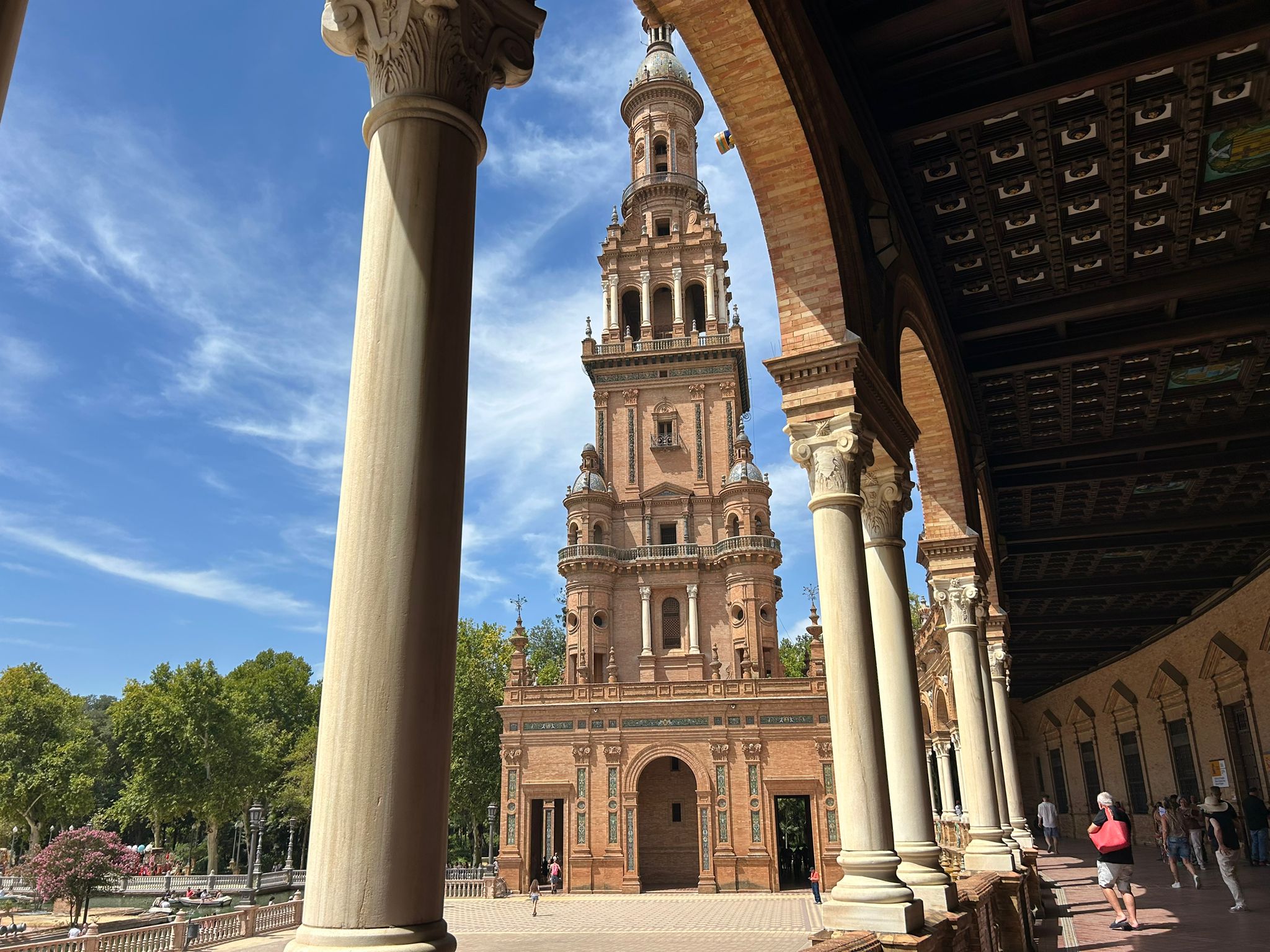
If you’re visiting the beautiful city of Seville for the first time, you absolutely shouldn’t miss this little piece of history. Because this place takes you back in time, to an era when life looked a bit different. The moment you walk toward it, it’s impossible to ignore. There it stands, in all its glory: grand, colorful, and almost fairy-tale-like. But what you might not know is that Plaza de España is much more than just a pretty picture. Behind this square lies a story of ambition, pride, world-politics, and an architect with a very big dream. And believe us: once you know that story, you’ll never look at this gem the same way again.
Seville on the World Stage
To understand why Plaza de España was built, we need to go back in time a bit. It’s the early 20th century. Europe is still recovering from World War I, countries are rebuilding, and at the same time, the idea of international cooperation, or at least: making an impression, is gaining momentum.
Spain no longer held the power and wealth it once did; it had lost most of its colonies in Latin America. Still, it wanted to strengthen ties with those countries—not to regain power, but to celebrate shared culture, language and history. That’s how the idea of the 1929 Ibero-American Exposition was born—a world fair at which Spain wanted to showcase its cultural, economic and political ties with Latin American countries. “Ibero” refers to the Iberian Peninsula (Spain and Portugal), and “American” is Latin America.
So it was a huge honor that Seville, not Madrid or Barcelona, was chosen to host this event. But that also meant a lot had to be done in preparation: there was planning and building to be done so that, come opening day, the city would be ready for the global spotlight. Buildings, pavilions, many new squares… but the most important project of all? Plaza de España.
The Grand Dream of Architect Aníbal González
For such an important square, a skilled architect was essential. That was Aníbal González, a famous Sevillian architect. He was already known for beautiful structures in the city like Plaza de América, but Plaza de España would become his greatest work, his masterpiece.
González had a clear vision. He wanted a square that would show Spain at its very best, not only in appearance, but in symbolism too. He designed a half-circle shape, as if the square were opening its arms to Latin America, welcoming once-colonies back as friends. A symbolic hug, if you like. That’s how both visitors and locals often see it.
Around the square would be buildings with elegant arches, towers, and colorful tiles. Along the walls would be 52 benches, each dedicated to one Spanish province. Each bench would feature a ceramic mosaic depicting historical events, maps, and coats of arms, like an open-air history lesson. Altogether, the square would be a celebration of Spain: its culture, its regions, its history. Interestingly, although Spain now has only 48 provinces, there are still 52 benches on the square today.
We call his style regionalism, a blend of Spanish and Moorish (Arab) influences, using plenty of brick, ceramics, arches, and tiles. All the vibrant colors and exotic forms really show how Seville embraced art, culture, and tradition. Not only does it reflect Spanish identity, but it also shows how significant Moorish influence has been on the city, its people, and architecture. Despite the many influences, the style is still distinctly Andalusian: perfect for Seville.
Problems at the Construction Site
Construction of Plaza de España began in 1914, right as World War I broke out. Still, the work continued through uncertain times. González worked passionately on his design, leading hundreds of craftsmen and artists. But a great project costs time, cooperation, and money, and that quickly led to issues.
After more than a decade of building, criticism grew. Some thought González’s style was outdated, or too flamboyant. Others argued it was taking too long or cost too much. The Expo organizers also wanted more say, they felt the talented architect was going off-script. One thing is certain: you can’t please everyone. Yet González persisted, showing his dedication by continuing his work.
Then in 1926, came the blow: González was dismissed. He wasn’t allowed to finish his own project. That must have been a bitter pill because he had devoted years of his life to it, and it became his life’s work; the place where he poured his creativity and passion. His successor was the architect Vicente Traver, who respected much of González’s vision, but also made several changes.
What Changed from the Original Design?
Traver kept the core elements intact: the half circle, the buildings, the ceramic tilework, the bridges. But he made subtle adjustments, adding elements from classical architecture: more symmetry, more Renaissance influence. Overall, the design became less colorful and imaginative than González originally envisioned, and people certainly had opinions about that.
The most notable change was the addition of the large fountain in the center of the square. That wasn’t in González’s original plan: he wanted the center open to let the buildings be fully visible. But Traver felt something was missing. In 1927, he introduced the fountain you still see today: graceful, symmetrical, a real focal point. And he was right; many people assume the fountain has always been there, though it was added later. It fits beautifully into the whole ensemble, completes the scene, and today it’s one of the most popular spots for photos or a shaded rest. While summer afternoons can be scorching, mornings and evenings are pleasant. Go at sunset, and you’ll be treated to spectacular color and light. And after August, the square remains quite comfortable even at midday.
When Was It Finished?
Though construction began in 1914, Plaza de España was only completed in 1928, just in time for the opening of the 1929 Ibero‑American Exposition. So the building process lasted fourteen years, which may seem long for a single square, but once you see how large, detailed, and unique it is, you understand why.
The Expo included more than just Plaza de España, such as the Mudejar Pavilion and the building that is now the Archaeological Museum, both located in Plaza de América. But Plaza de España was undeniably the highlight. Visitors from around the world came to Seville to admire Spanish culture, and this square showcased what Spain could achieve. The richness of history and art is reflected again and again throughout the city, in places beyond this jewel, some of which are local favorites.
After the exposition, the square took on new life. It became a beloved walking area, a place to rest, and later a film location (think Star Wars and Lawrence of Arabia). It’s still used for events today, like June’s Icónica Sevilla Fest. Nowadays, it remains one of Seville’s most visited landmarks, and a fixture on our bike tours of the city, of course. Because you truly can’t miss this.
Will You Ride With Us Through This Special Square?
If you join our bike tour through Seville, we always stop at Plaza de España. Not just because it’s beautiful, but because it’s a place where you can feel history. Here you see how Spain wanted to present itself to the world. Here you feel Aníbal González’s pride. You hear the fountain’s gentle murmur and see the colorful tiles shining in the sun.
And the best part? You experience it all from your bike. You ride across the bridges, curve around the half-round plaza, and feel yourself become part of the story. That’s what makes our tours special: we let you not only see the city, but feel and understand both its history and its people and culture.
So: are you ready to truly discover Seville? Book one of our bike tours, hop on, and pedal through the history of Plaza de España. We’ll tell you the full story on the way!
Tip: Want more blogs or ready to sign up for a tour right now? Check our website or follow us on Instagram for fun updates, photos, and helpful tips for your visit to Seville!
Instagram: @atd.spain
Facebook: Andalucía Tours and Discovery
TikTok: @ATD.spain
Website: atdspain.com
Address: Calle Alcalde Isacio Contreras 1, 41003 Seville, Spain

