
Chances are you are familiar with María Luisa Park because of its iconic Plaza de España square, but behind the wide paths and palm trees in the park lies a world full of hidden symbolism, forgotten details and surprising stories. María Luisa Park was the setting for the Ibero-American Expo of 1929, and the park was thoroughly redesigned and expanded for this huge event. The 1929 Expo gave the park a monumental character and made it even more cultural than it already was. After reading this blog, you will know at least five interesting facts about the park.
The glorietas intended as literary manifestos
When you walk through Maria Luisa Park, you pass several glorietas without realising that many of them were literally designed as open-air poems.
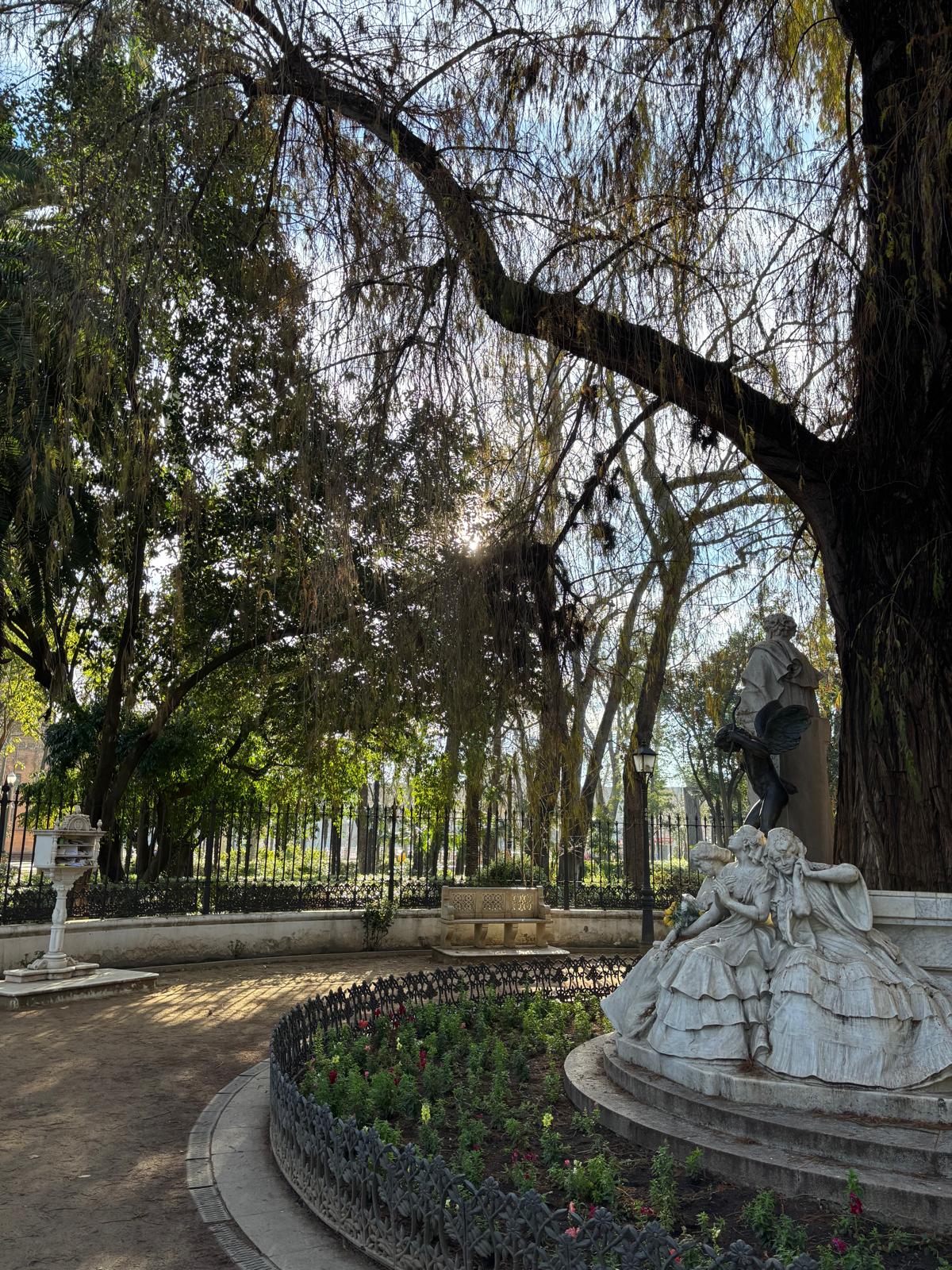
A well-known example of such a glorieta is the Glorieta de Bécquer. What few people know is that the three female figures symbolise not just ‘love’ in general, but the three different phases of love. These are hopeful love, fulfilled love and lost love. The arrangement is deliberately designed in a theatrical form, so that you can read the story as you walk around it. There are also two dark sculptures representing Eros and Cupid, Eros for wounded love and Cupid for love that wounds.
Every detail of the glorietas is tailored to the character of the honoured writer or artist. They are therefore cultural statements in ceramic and stone, rather than simply decorative features. If you happen to pass by the Glorieta de Bécquer, you can place your love letter on a marble bookshelf, which is very popular there. You will also see many people reading there; it is a quiet and peaceful spot.
Fuente de las Ranas
The Fuente de las Ranas may seem very playful, but it is very carefully constructed. The name of the fountain means ‘Fountain of the Frogs’ and it is a very well-known meeting place.
The eight frogs spray water towards the center, where a duck rests on a turtle. It is also described as the harmony between water, earth, and life. The fountain was also placed so that the sound of the water forms a natural sound against the surrounding avenues. The colourful glazed tiles and natural stone base reflect the Sevillian craft tradition. The animal figures symbolise liveliness.
Many Sevillians have recreated this fountain in miniature in their patios, something you may never have noticed.
The park as a place to get lost
French landscape architect Jean-Claude Nicolar Forestier redesigned the park at the beginning of the 20th century, with the aim of creating an experience.
He deliberately designed the path system to be organic and slightly asymmetrical. This causes you to subtly lose your sense of direction. His idea was to give visitors little “moments of discovery” along the way, such as a hidden bench, the glory arch, the Fuente de las Ranas, etc.
The park is therefore not a normal straight walking path, but a unique walk.
A hidden oasis in the park
Tucked away among all the green spaces in María Luisa Park is the charming Jardín de los Leones. This entirely Arabic-style Garden consists of several ponds with lion statues and various elegant fountains.
But that’s not all you can see in this intimate setting, because here you will also find Monte Gurugú. This is an elevated viewpoint that offers a beautiful view of the garden and is the perfect place to take a beautiful photo.
What makes this place so special? It is virtually unknown, which means only one thing: an oasis of tranquillity, the gentle sound of water, lovely shady corners, and a meditative atmosphere. Jardín de los Leones is the perfect place to escape the hustle and bustle, find yourself, read a book, eat a sandwich, or enjoy a moment of peace with your companions.
A fairytale island
Halfway through your walk in María Luisa Park towards Plaza de España, you will discover a small, almost hidden oasis called Isleta de los Patos. This is a pond where swans and other birds float peacefully in the water. It is a very romantic scene.
In the middle of the pond, you will also find the Pabellón Alfonso XII, a historic pavilion named after King Alfonso XII and built with elegant neo-Arabic arches. The reflection in the water, the tranquillity of the surroundings and the intimate atmosphere make this one of the most romantic spots in the park. This also makes it quite popular for marriage proposals.
Here too, landscape architect Jean-Claude Nicolas Forestier attempted to give the Isleta de los Patos a Moorish romantic style. The pond also features a combination of Mediterranean plants and water and garden elements, creating an oasis of tranquillity in the city.
Hidden stories
The María Luisa Park is therefore more than just a green park; it is a carefully composed landscape full of symbolism, architectural experiments, literary tributes, and a botanical strategy.
Next time you walk through María Luisa Park, pay attention to the details, because that’s where the real story is hidden.
Would you like to see these five fun facts about María Luisa Park in real life? Our daily bike tour takes you past all the city’s highlights, including María Luisa Park. If you have any other questions, we are more than happy to answer them. Whether online or in our shop, we are happy to help.
Adres: Calle Alcalde Isacio Contreras, 1, Sevilla
Website: www.atdspain.com
Instagram: @ATD.spain
TikTok: @ATD.spain
Facebook: Andalucia Tours and Discovery

