
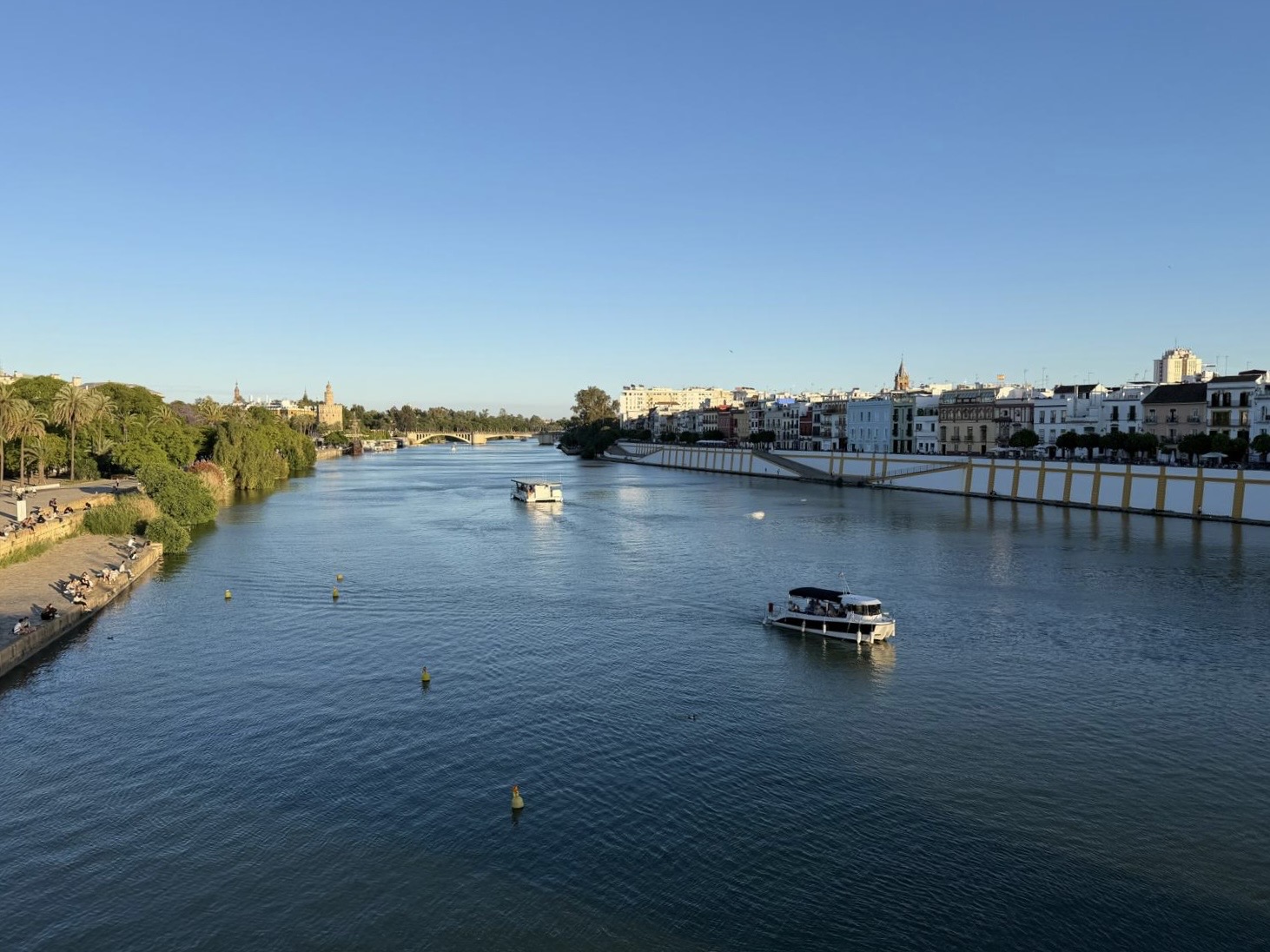
When you think of Seville, flamenco, orange trees, tapas, and sweltering summers
may come to mind. But running right through the heart of all that liveliness is
something just as important to the city: the Guadalquivir. This river is actually the
reason Seville was able to grow into one of Spain’s most important cities. Without
the Guadalquivir, Seville would likely never have become as wealthy, famous, and
vibrant as it is today.
The river runs through a large part of Andalusia and eventually flows into the Atlantic
Ocean. The name “Guadalquivir” comes from Arabic: al-wadi al-kabir, which literally
means “the great river.” That really says it all. During the Moorish rule, the river
played a huge role in trade, agriculture, and transportation.
A River Steeped in History
For hundreds of years, the Guadalquivir has been vital to Seville. As far back as
Roman times, the river was already used for trade. Ships carried oil, wine, and other
goods to other parts of Europe. Later, during the Islamic period, Seville continued to
grow into a major trading city.
The true golden age, however, began after the discovery of America in 1492. Seville
then gained a near-monopoly on trade with the New World. All ships coming from
America to Spain had to pass through Seville. As a result, gold, silver, and exotic
goods poured into the city. The Guadalquivir literally became a highway to wealth.Because the river does not flow directly into the sea, Seville was also better
protected against pirate attacks than coastal port cities. This made the city
particularly attractive to merchants. For a long time, Seville was thus one of the
wealthiest cities in Europe.
The Nao Victoria: A Ship That Made History
One of the most famous ships associated with the Guadalquivir is the Nao Victoria.
This ship was part of the expedition led by Ferdinand Magellan and Juan Sebastián
Elcano. What makes this ship so special? It was the first ship ever to complete a
voyage around the world.
The expedition set sail in the early 16th century from Seville via the Guadalquivir
toward the ocean. Of the five ships that began the journey, only the Nao Victoria
ultimately returned. The voyage lasted nearly three years and was extremely
arduous. Many crew members did not survive.
Today, there is a replica of the ship in Seville that tourists can visit. It clearly shows
just how small and fragile those ships actually were. It’s pretty bizarre when you
consider that people literally sailed around the world in them.
Tourism on and around the river
The Guadalquivir is no longer Spain’s main trade route, but the river still plays a
major role in the daily life of Seville. Tourism, in particular, has become hugely
important.
Wide walking paths run along the river, where there’s always something going on.
People jog, bike, sit at outdoor cafes, or watch the sunset. The atmosphere is
especially lively in the evening. The river also provides some relief from the heat
during the hot summers, when temperatures easily exceed 40 degrees.
A popular activity for tourists is the river cruise. From the water, Seville looks very
different. During such a boat tour, visitors sail past famous landmarks such as the
Torre del Oro, the Triana district, and various historic buildings. Many tourists choose
this option because it’s a relaxed way to explore the city without having to walk for
hours in the heat.
The boats have now truly become part of the cityscape. During the day, they
constantly cruise back and forth with tourists taking photos of Seville’s skyline.
Rowing on the Guadalquivir
It’s not just tourists who make use of the river. The Guadalquivir is also important for
sports. Seville is known as one of the best rowing cities in Spain. This is because the
water is relatively calm and the climate remains favorable almost all year round.Rowers and canoeists train along the river every day. International competitions are
even held here. Especially in the morning, you can often see sports teams gliding
across the water as the city slowly wakes up.
For many residents, sports on the river are simply part of Seville. So the
Guadalquivir isn’t just something beautiful to look at, but also a place where people
are actively engaged.
The Bridges of Seville
A river running through the heart of the city naturally means bridges. Seville has
several well-known bridges spanning the Guadalquivir, but the most famous is
probably the Puente de Triana, officially known as the Isabel II Bridge.
This bridge connects the center of Seville with the Triana district. Triana is known for
flamenco, ceramics, and a slightly more local atmosphere. The bridge itself was built
in the nineteenth century and bears a slight resemblance to the bridges in Paris.
In addition to this historic bridge, modern bridges have also been built, primarily for
the 1992 World’s Fair. As a result, Seville now features a mix of old and modern
architecture along the river.
More Than Just Water
The Guadalquivir is much more than just a river. It is the place where Seville’s
history began and where a large part of city life still converges. From explorers and
merchant ships to tourist boats and rowers: almost everything in Seville has a
connection to the river.
Perhaps that is also what makes the Guadalquivir so special. It is not a river that
“just lies there,” but a river that is truly alive. Without the Guadalquivir, Seville would
never have been the same and likely would never have become so popular with
tourists from all over the world. Would you like to experience the Guadalquivir River
for yourself in a fun way? On our daily bike tour, we cycle along a section of the river
with several stops. If you have any other questions, we’d be happy to answer them.
Whether online or in our store, we’re here to help!
Adres: Calle Alcalde Isacio Contreras, 1, Sevilla
Website: www.atdspain.com
Instagram: @ATD.spain
TikTok: @ATD.spain
Facebook: Andalucia Tours and Discovery

