
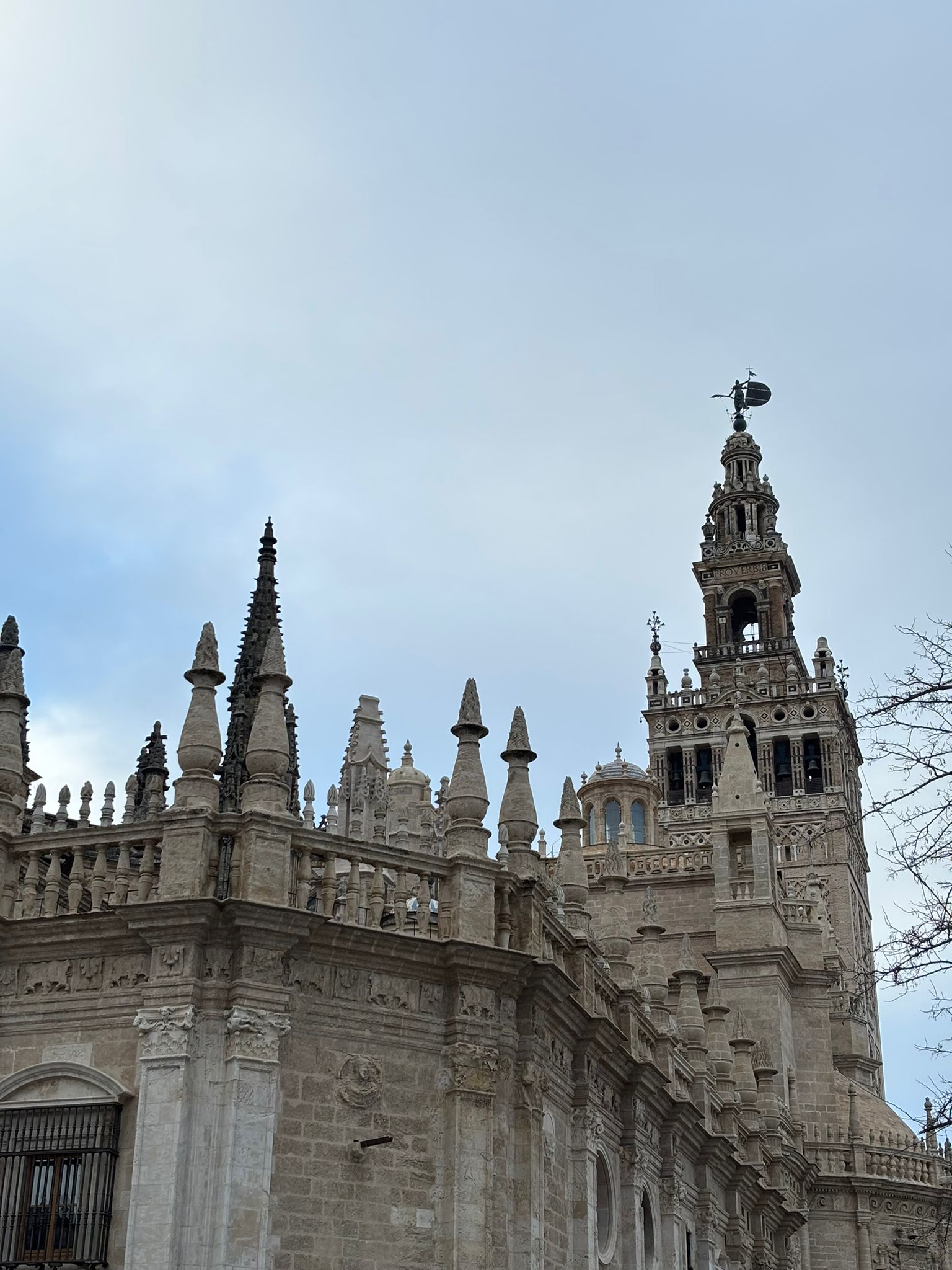
When you walk around the Cathedral of Seville, it may seem as if you are simply strolling past an old building and silent walls. But if you look closer, you will discover that every corner of the Cathedral tells a different story. From pillars and chains to centuries-old graffiti and Marian devotion, this Cathedral is not just a normal building, but is steeped in history and stories. In this blog, I will take you on a tour of the Cathedral and show you three special features: the pillars and chains around the Cathedral, the centuries-old graffiti los Vitores and the story behind la Virgen del Olmo.
First, some general information about the Cathedral of Seville: it was built between 1401 and 1519 on the site of a former mosque. the Cathedral of Seville is the largest Gothic cathedral in the world and is now best known for its iconic bell tower called Giralda.
The pillars and chains surrounding the Cathedral
When you walk around the Cathedral of Seville, one feature often catches your eye: the pillars connected by iron chains. But have you ever really looked at those pillars with iron chains around the cathedral? At first glance, they may seem mainly decorative, but in the 16th century they were anything but decorative. What do you see when you look at those 157 pillars and large iron chains? In the 16th century, there were two legal systems: number one, the secular law of the city, and number two, the ecclesiastical law of the Cathedral. These two different laws regularly clashed.
The first legal system was secular law, the ordinary judicial power of the city. The second legal system was ecclesiastical law, the jurisdiction of the church, which had its own rules and protection. These two jurisdictions regularly clashed, because one wanted to maintain order and the city, while the other determined its own rights.
The Cathedral’s grounds began within the chains, and the right of asylum applied there. Anyone who managed to reach the sacred area, also known as sacral territory, could not be arrested by the city guards, called the alguaciles. Criminals, debtors, and even political refugees literally ran for their lives when they headed for the Cathedral.
The chains between the pillars were much more than just decoration. They provided a clear demarcation between the different legal systems. They also served to prevent shopkeepers and others from engaging in activities that were not appropriate in the sacred space, thus preventing them from entering the Cathedral.
Los Vitores, centuries-old graffiti
If you look closely at the facades, you can sometimes see reddish marks and letters. They almost resemble mysterious and magical symbols from a fantasy book, but these are not secret codes, they are los Vitores.
In the late Middle Ages, a ‘Vítor’ was a kind of academic honorary title. When someone obtained their doctorate, it was celebrated with such a symbol on the walls of universities and other important buildings. The best-known sign is a capital V surrounded by a C, T, , O and R, and together Vítor. This means “Long live (name of the honoree)!”
So, where we now take a photo for our Insta story or Facebook, people used to proudly scratch a Vítor on the wall of the cathedral. How cool is that? When they were cleaning the facade, the signs reappeared and suddenly the walls of the cathedral were covered with centuries-old success stories.
La Virgen del Olmo
On the east side of the Cathedral on the Giralda, this is the famous bell tower monument of the Cathedral of Seville. Here you can see a niche with a statue of Mary with the Christ Child, also known as La Virgen de los Olmos. The statue is very small in size and, although not conspicuous, it has great and rich significance.
The statue dates from the 14th century and is an anonymous sculpture. It originally stood at the Corral de los Olmos, the place where the chapter of the diocese met.
This corral got its name from the presence of elm trees (the Olmos), which at that time were known as a symbol of strength and steadfastness in faith. In 1791, the Corral de los Olmos was demolished and the statue was moved to the eastern façade of the Giralda, so the statue you see outside is a replica from 1986.
The statue is also very small and has a very symbolic meaning, which is what makes it so special:
- Mary is gently holding the child.
- The child is playfully touching her crown.
- Mary is carrying flowers, which is a symbol of mercy.
- Mary and the child look at each other lovingly, conveying an image of human tenderness.
The statue follows the Hodegetria model, Mary as “she who shows the way”. In this way, Mary is not only depicted as a mother, but also as the one who shows believers the way to Christ.
General information about the Cathedral of Seville
To admire the Cathedral, it is open Monday to Friday from 11:00 to 18:00 and on Sundays from 14:30 to 19:00. The Cathedral is closed on 1st and 6th January, Good Friday, and 25th December. If you would like a private tour of the Cathedral of Seville, please contact us and we will arrange it for you.
Would you like to see these three special details of the Cathedral of Seville in real life? Our daily bike tour takes you past all the city’s highlights, including the Cathedral of Seville.
Adres: Calle Alcalde Isacio Contreras, 1, Sevilla
Website: www.atdspain.com
Instagram: @ATD.spain
TikTok: @ATD.spain
Facebook: Andalucia Tours and Discovery

