
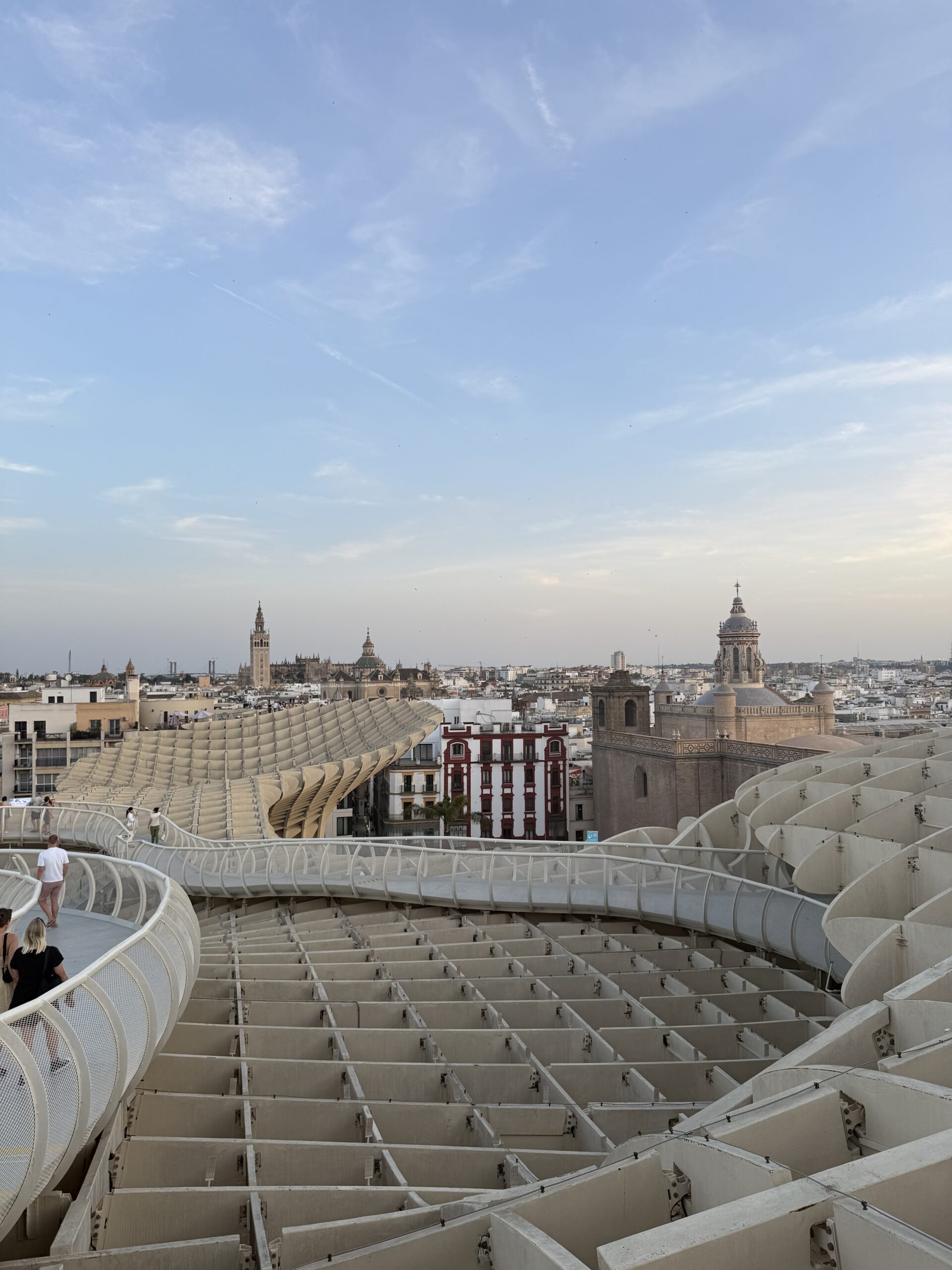
When you walk through the Plaza de la Encarnación in Seville, it’s hard to miss the bold curves and towering shade of Las Setas de Sevilla, or “the Mushrooms.” This massive wooden structure, officially known as the Metropol Parasol, is one of the most modern and surprising landmarks in the city. But did you know that beneath its futuristic walkways and panoramic rooftop lies something much older?
Hidden just below the plaza is a time capsule from 2,000 years ago: the Antiquarium of Seville, a fascinating archaeological museum where you can explore Roman and Moorish remains uncovered during the construction of the Setas. For lovers of history or anyone who enjoys seeing how the past and present meet this underground site is a quiet, air-conditioned treasure.
What is the antiquarium?
The Antiquarium is an underground museum located directly beneath the Setas, featuring an impressive collection of Roman mosaics, houses, and fish-salting basins that once belonged to the ancient city of Hispalis the Roman name for Seville.
The ruins were discovered in the early 2000s during excavation work for a planned parking garage. Once archaeologists realized the scale and importance of the findings, the city changed its plans. The garage was scrapped, the modern structure was redesigned, and Seville gained not just a stunning new landmark above ground but a museum preserving centuries of history below.
What you’ll see inside
The Antiquarium is quiet, well-lit, and beautifully laid out. Walkways and glass platforms let you explore the ruins without disturbing them, and signs in Spanish and English explain what you’re seeing.
Some of the highlights include:
• Roman houses, complete with inner courtyards, wall paintings, and floor mosaics. You can clearly see how people lived, cooked, and decorated their homes almost two millennia ago.
• A salting factory, where fish were preserved in salt to be exported throughout the Roman Empire an essential part of Hispalis’s economy.
• Remains from the Islamic period, including parts of walls and drainage systems from when Seville was an important city in Al-Andalus.
• Artifacts such as ceramics, tools, coins, and decorative pieces that bring the ancient world to life.
The museum also uses projections and interactive screens to help visitors visualize what these ruins would have looked like in their original form.
A unique atmosphere
One of the best things about the Antiquarium is its atmosphere. While the streets above may be bustling with locals, markets, and tourists, the space below is calm and cool a perfect escape from the heat and noise of the city.
It’s a place that invites reflection. As you walk along ancient Roman streets, you’re reminded of how long Seville has been a vibrant, complex, and inhabited place long before the cathedral bells rang or flamenco echoed through the streets.
Make the most of your visit
If you’re planning to visit the Setas for the sunset view from the top, try to stop by the Antiquarium first. It gives you a totally different perspective on the space you’re standing in. What looks like a modern plaza above was once a bustling Roman neighborhood, full of life, trade, and culture.
A city of layers
Seville is a city built in layers. Roman, Islamic, medieval, baroque, and modern each one stacked carefully on top of the last. Nowhere is this more literal than at Las Setas, where wooden waves stretch into the sky while mosaic floors lie preserved below your feet.
Visiting the Antiquarium is a quiet reminder that Seville has always been a crossroads of cultures, a place where the old doesn’t disappear — it becomes the foundation for what’s next.
So next time you’re admiring the curves of Las Setas from a café terrace, take a few steps down the stairs and explore the ancient streets beneath your feet. You might leave with a new appreciation for just how deep Seville’s story runs.

