
Just 33 km northeast of Seville, perched on a limestone ridge, Carmona offers an immersive journey through millennia—from prehistoric settlement, Roman grandeur, Moorish transformation, to medieval and modern Spanish life—all within a peaceful 8 hectare historic center.
1. Ancient Roots & Roman Power
Carmona’s first traces date back to the Neolithic and Chalcolithic periods, evolving through Tartessian culture before emerging as a major Roman city along the Via Augusta, a vital route linking Híspalis (Seville) to Córdoba and the wider Empire .
Roman Necropolis: Death & Religion
Located southwest of the amphitheatre, this necropolis—active 1st–2nd c. AD—contains over 200 tombs hewn into bedrock: family mausoleums, urn pits, frescoed chambers, stone benches, and columbaria.
- Tomb of Servilia: A lavish villa-style tomb with colonnaded courtyard, vaulted chambers, statues, and a monumental vestibule—built for an elite Roman family .
- Tomb of the Elephant: A unique multi-chambered complex with possible Mithraeum origins—aligned with equinox sunlight and featuring an elephant statue, fountained shrine, and stone benchesThe equinox-aligned window may have illuminated a Mithras statue—an early temple turned burial site .
- Roman Amphitheatre: Carved into the hillside, seating ~18,000 spectators. Excavated from 1885 under Bonsor and López, parts include ima/media cavea and rock-carved passageways.
2. Islamic Era & Moorish Foundations
From the 8th to the mid-13th century, Carmona—known then as Qarmūnâ—was a fortified Muslim stronghold and capital of a Taifa kingdom. In 763, it hosted a decisive battle that cemented Abd-ar-Rahman I’s rule in al-Andalus. The urban grid, mosque layout, and stone-cut quarries(later the Cueva de la Batida) reflect this high medieval phase .
3. Christian Reconquista & Gothic Transformation
Carmona capitulated peacefully to King Ferdinand III in 1247, retaining its Muslim population under terms of coexistence . Over the next centuries, the mosque converted into:
- Iglesia de San Felipe: A former mosque turned church, with minaret-base, Mudéjar timber ceilings, and a Renaissance altar .
- Iglesia Prioral de Santa María: Construction began in 1424, finishing 1551. This late-Gothic hall church preserves the mosque’s Patio de los Naranjos (courtyard). Inside, Gothic ribbed vaults, a Plateresque altarpiece by Vázquez (1559–), Baroque chapels, and the 1724 Virgen de Gracia statue showcase artistic evolution; even a Visigothic calendar is carved on a courtyard pillar .
4. Alcázar & Fortress to Parador
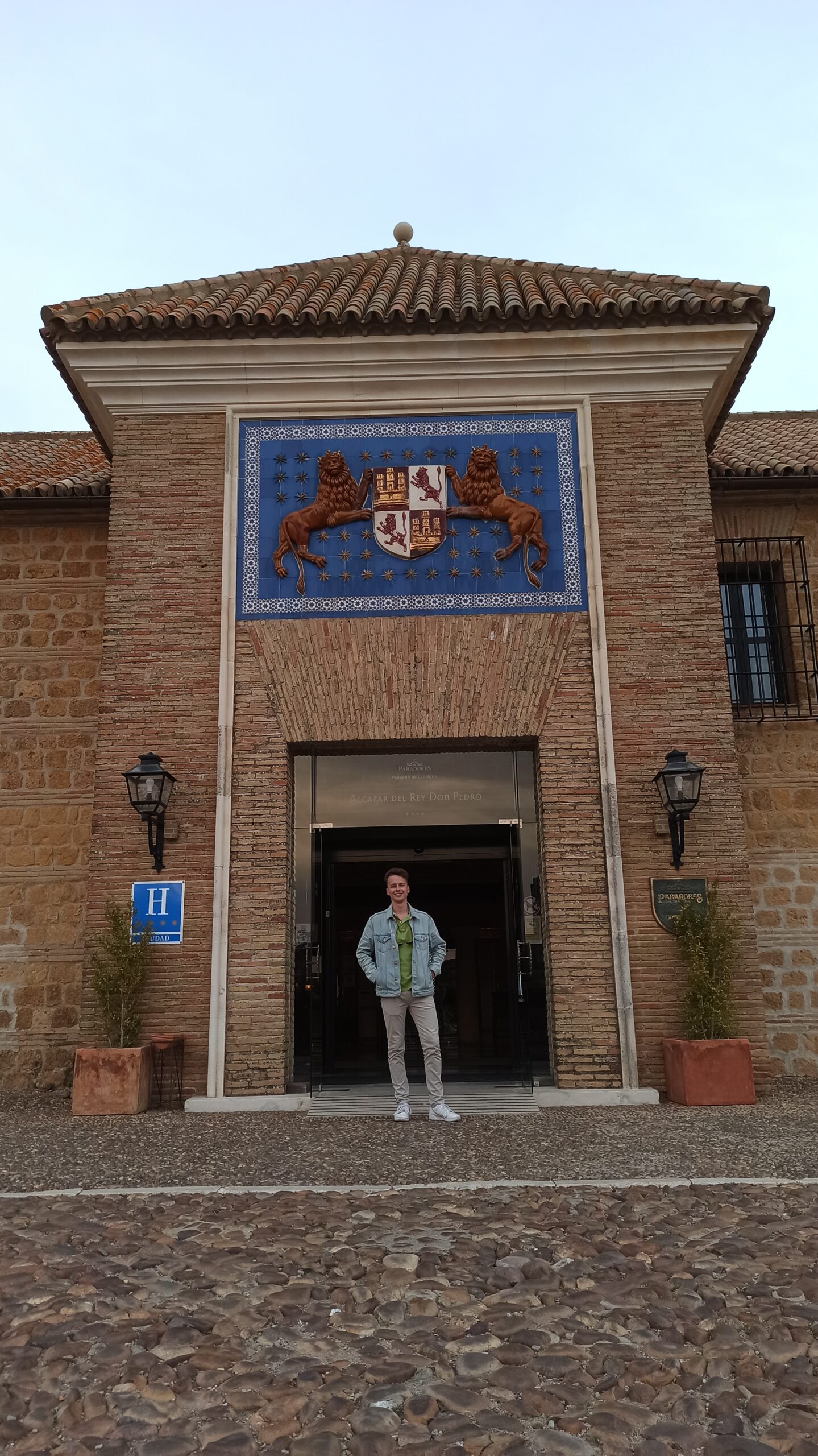
The Moorish fortress was rebuilt and fortified by King Pedro I in the 14th century, adding towers and artillery sections like El Cubete . It later became a royal residence and now is preserved as the Parador de Carmona, offering visitors the chance to have coffee or dine in medieval halls overlooking the plains.
5. Cueva de la Batida & Roman Quarry
These medieval stone quarries have operated from Islamic through Christian times. Today’s Cueva de la Batida—along the ancient road to the Puerta de Córdoba—is filled with Arabic inscriptions and carved altars, indicating ritual use/weathering by quarry workers or hermits .
6. George Bonsor: Carmona’s Archaeology Pioneer
An English-French painter turned archaeologist, George Bonsor (1855–1930) spearheaded Carmona’s excavations in 1881. He co-founded the Sociedad Arqueológica de Carmona (1885), documented tombs and amphitheatre, donated artifacts to Spain, and cemented Carmona’s legacy as a treasure trove of Roman archaeology.
7. Torta Inglesa: Carmona’s Sweet Heritage
This puff-pastry filled with cabello de ángel was named after an English traveler—believed to be Bonsor—who loved the cake and popularized it in the late 1800s. Today, you can taste authentic versions at La Nevada bakery or at the Santa Clara convent.
Visiting Carmona from Seville
By car: 30–40 min via A-4 with free parking near necropolis and Puerta de Córdoba.
By bus: Hourly Casal service from Plaza de Armas (8:00–20:00); return from Av. de Portugal (~3–4 €).
All major sites lie within a 10–15 min walking radius: Puerta de Córdoba → Alcázar/Parador → Santa María → Museo Marqués de Torres → Necropolis & Amphitheatre → Cueva de la Batida.
Best Time & Events
Visit during spring (Mar–May) or autumn (Sep–Nov) for mild weather and calm streets. Avoid midday heat in summer. For cultural vibrancy, join Carmona’s Holy Week, Corpus Christi, September Romería, or Patron’s festivities in July–August.
Summary: Why Carmona Should Be on Your Seville Itinerary
- Roman marvels: tombs, Mithraeum theories, amphitheatre
- Islamic heritage: fortress stones, street layout, mosque echoes
- Christian artistry: Mudéjar ceilings, Gothic vaults, Plateresque altars
- Living history: walk through eras within arm’s reach
- Sweet reward: local cake linked to Carmona’s archaeological fame
In one day, Carmona delivers centuries of architecture, beliefs, and tastes—undisturbed by crowds. It isn’t just a trip out of Seville—it’s a journey through the heart of Andalusia.

