
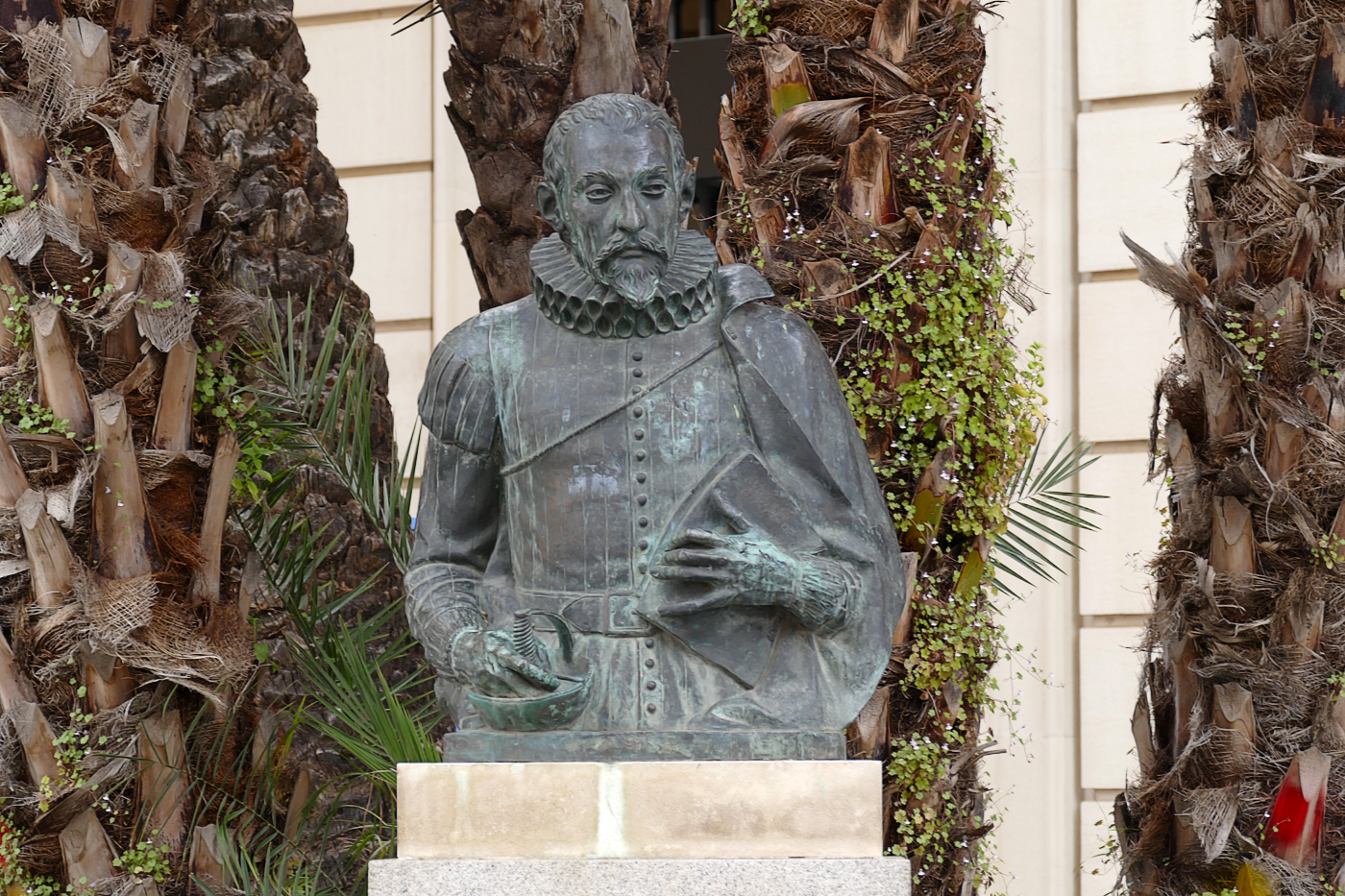
If you have even a small interest in history, especially that of Seville and Spain, you might enjoy learning more about Miguel de Cervantes. This man was an important figure in the history of Seville, and without the information we can find in his book Don Quixote, we might not have known so much about the city’s past. It is quite special to think that we can look back over 400 years simply because one man documented life in his time. In his lifetime, Cervantes traveled through eleven towns in the province. Today, you can follow the Cervantes Route, a path that allows you to walk in his footsteps and discover the cultural heritage of the Andalusian towns he visited as an officer of the King and his royal treasury. A true treasure that has been preserved in the works he wrote.
Who is Miguel de Cervantes?
Miguel de Cervantes, born in 1547 and died in 1616, was a Spanish novelist, playwright, and poet, best known as the author of Don Quixote (written between 1605 and 1615). He is considered the most important and celebrated figure in Spanish literature. His novel Don Quixote has been translated, fully or partially, into more than 60 languages. That is an incredible number, which shows the importance of this work. Even today, new editions are still being printed, and since the 18th century, critics have continued to study and debate his work. The characters Don Quixote and Sancho Panza have become some of the most famous literary figures in the world, appearing in art, theater, and film. Cervantes loved to experiment with writing and tried nearly every literary genre, except for epic poetry. He also wrote short stories, in which he was particularly talented. His collection Novelas ejemplares (Exemplary Novels, 1613) contains stories that are almost as powerful and remarkable as Don Quixote, but in a shorter form.
Cervantes was born near Madrid, about 32 kilometers from the city. It is said that he was born on September 29, Saint Michael’s day, which may explain his name. What we do know for certain is that he was baptized on October 9 and was the fourth of seven children in his family. His father was a barber-surgeon, but not much else is known about his early years. Unlike many Spanish writers of his time, who often came from humble origins, Cervantes probably never studied at university. However, he became a true lover of books. In 1569, Juan López de Hoyos, the head of a municipal school in Madrid known for his modern ideas, referred to Cervantes as his “beloved pupil.” Cervantes was 21 years old at the time. If this was indeed the same Cervantes, then he must have been either a student-teacher at the school or a former student. Around the same time, his first poem was published.
The special bond between Cervantes and Seville
On January 10, 1588, Miguel de Cervantes decided to settle in Seville. From there, he traveled through different towns and villages in the province, such as Carmona, Écija, and Marchena, purchasing goods like olives, oil, wheat, and barley. He did this as a commissary of supplies for the King’s ships. However, this task was not without problems. When he also seized goods from the Church, he was even excommunicated by the Archdiocese of Seville. In 1594, he was given another job as a tax collector. He had to recover unpaid taxes to help finance Spain’s costly wars. This was a very difficult task since many people could not or would not pay. During a trip to the Kingdom of Granada, he was responsible for collecting large sums of money, but much of it never reached him. Later, when the accounts did not add up, Cervantes was held responsible for the missing money. In 1597, he ended up in the Royal Prison of Seville for several months. According to the prologue of his most famous work, Don Quixote, it was in that prison where the idea for the story was born. We cannot be sure whether he actually started writing there or just imagined the plan, but his time in Seville and in prison became a turning point both in his life and in world literature.
The prison of Seville
In the heart of Seville, on the well-known Calle Sierpes, once stood the Royal Prison (Cárcel Real). Its origins go back to the 13th century, after King Ferdinand III reconquered the city. For centuries, this was a place where prisoners served their sentences, but it became especially famous because Miguel de Cervantes himself was imprisoned there. According to tradition, it was inside these walls that he began to write what would later become the most important novel in Spanish literature: Don Quixote of La Mancha. Cervantes was not the only well-known figure imprisoned there. Other important men of the Spanish Golden Age also spent time in those cells, including the writer Mateo Alemán, the painter and sculptor Alonso Cano, the sculptor Martínez Montañés, and the clockmaker Bartolomé Morel. This gives the prison a special historical and cultural value, as it became a place where hardship and creativity were deeply connected.
In the 19th century, the prison was demolished, and the site had many different uses and owners afterward. Today, the tavern Entrecárceles is located there, a place where visitors would hardly imagine that prison cells once existed. However, the memory lives on. A commemorative plaque from 1905 and a ceramic plaque from 1984 recall the history of the Cárcel Real, while a statue of Cervantes at the back of the building honors the writer who began his greatest work in confinement. Seville keeps its history alive, and the Royal Prison is a perfect example: a place where pain and creativity came together and where Cervantes laid the foundations of his world-famous novel.
Seville in Cervantes’ works
If you walk through Seville today, you can still find places connected to Miguel de Cervantes. The most famous is Calle Sierpes, a busy shopping street in the city center. This was once the location of the Royal Prison where Cervantes was held. The building no longer exists, but plaques and a statue still remind us of him. In the neighborhood of Triana, across the Guadalquivir River, you can also find traces of his presence. In his time, Triana was a working-class district, full of potters, fishermen, and craftsmen. The lively street life there probably inspired Cervantes, and you can feel this influence in his stories. Walking through the narrow streets and squares, it is easy to imagine what life was like back then. He also likely visited places such as the Iglesia de Santa Ana and local taverns where people gathered. These were the settings where he observed everyday life, later reflected in his works. Following his footsteps around the city not only brings you closer to Cervantes but also allows you to experience Seville’s own history in a very vivid way.
Cervantes and the bond with Triana
Cervantes had a special connection with Triana, the lively neighborhood on the other side of the Guadalquivir. In the 16th century, this was an area where ordinary people lived: potters, fishermen, artisans, and performers. The streets were always full of life, with busy taverns, markets, and narrow alleys where everyone knew each other. This daily life probably gave Cervantes inspiration for his characters and stories. He always had an eye for the common people, and Triana offered him plenty of real-life examples. The river itself was also very important, as it was the departure point for ships sailing to the New World. Merchants, sailors, and adventurers all gathered here, making Triana a melting pot of cultures and ideas. Cervantes must have found this both fascinating and inspiring. Today, the neighborhood has kept its unique atmosphere. Walking by the Iglesia de Santa Ana or along the riverbanks, you can easily imagine Cervantes himself wandering these streets, gathering inspiration.
Why Cervantes still lives on in Seville
Cervantes may have died centuries ago, but in Seville, his memory is still alive. You find his name and his stories all over the city: on squares, in streets, and on commemorative plaques. For the people of Seville, he is not only a famous writer but also a part of their own identity. For visitors, this makes the city extra special. Walking through Seville, you do not just see beautiful buildings and squares, you also feel like you are stepping into a living story. The city is proud of Cervantes, and by exploring Seville, you quickly understand why his spirit still lingers here. Although the old prison is long gone, you can still pass by where it once stood, and that makes it a fascinating stop on any visit.
Join a tour with us!
Would you like to discover the city while diving into its history? Then book your bike tour with us! Our amazing guides will make sure you have an unforgettable experience, full of stories and fun. Together, we will explore Seville on two wheels, in a group or privately, and bring the city’s history to life for you. One thing is certain: you will not be bored with us!
Contact:
Address: Calle Alcalde Isacio Contreras 1, Seville
Website: www.atdspain.com
Instagram: @atd.spain
TikTok: @ATD.spain
Facebook: Andalucia Tours and Discovery

