
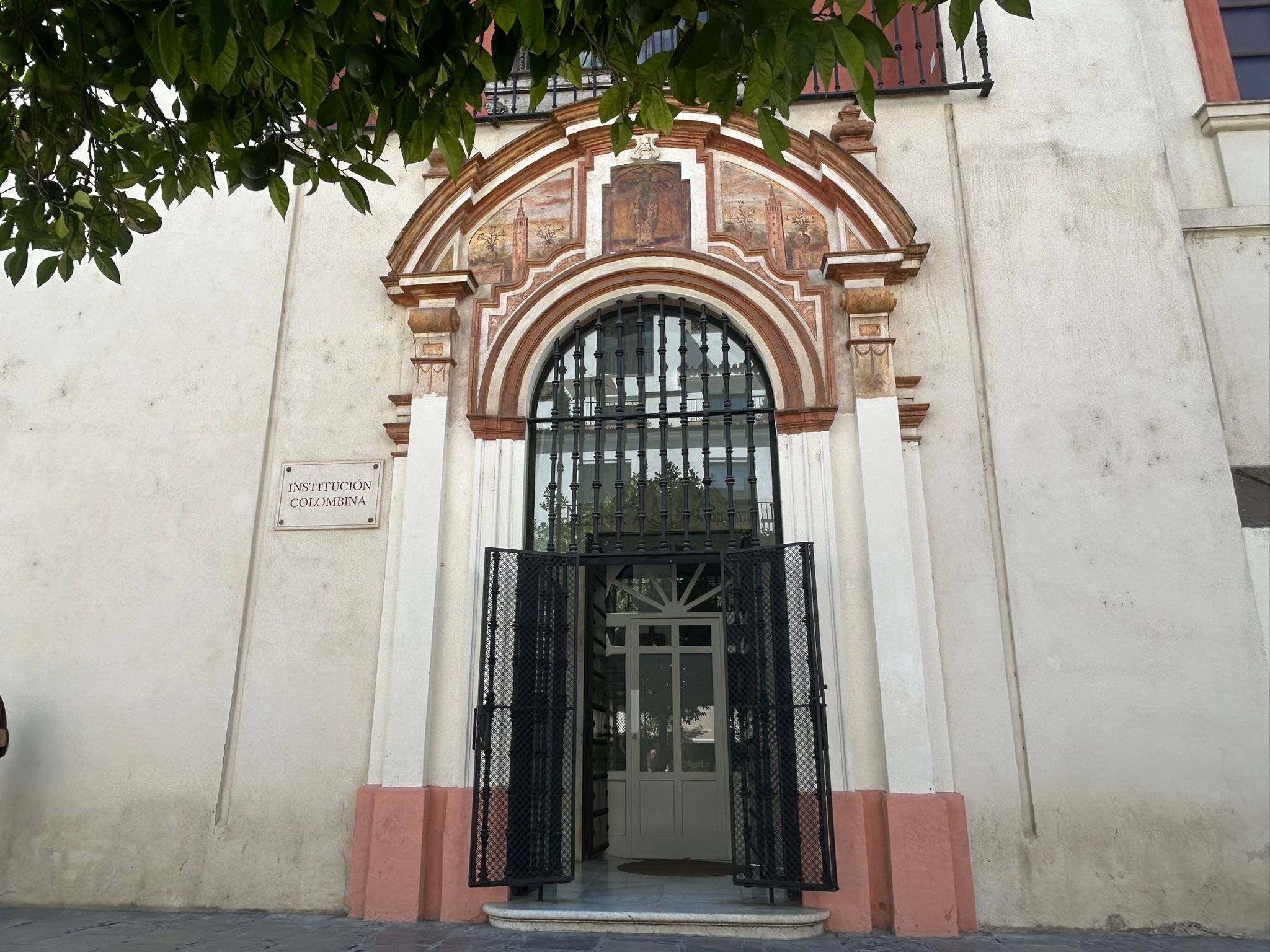
If back in school you loved diving into history books to discover as much as possible about the world of the past, then this blog is made just for you. Seville is known for its beautiful cathedral, the impressive Alcázar, and its lively squares, but there are also lesser-known gems that are just as valuable to visit. Behind the bustling city life hides a unique institution that preserves an enormous amount of knowledge and heritage: La Institución Colombina. For many it is an unfamiliar name, but for those interested in history, literature, and the voyages of Columbus, it is an absolute must. From the outside, you won’t immediately see its splendor, but once you dive into this heritage, you discover a quiet power that reflects Seville’s role in world history.
What is La Institución Colombina and where does it come from?
La Institución Colombina is a historic library and archival institution located in Seville. What makes it special is its close connection with the legacy of Christopher Columbus and his son Hernando Colón. Hernando was a passionate collector of knowledge. In the early 16th century, he decided to build one of the most ambitious libraries of his time: the Biblioteca Colombina. His goal was truly extraordinary: to own a copy of every book in the world. He collected thousands of works, not only from Spain but from all over Europe, laying the foundation for a unique collection that has been preserved in Seville up to this very day. Later, through royal decrees and church protection, the library became part of the Cathedral of Seville. This gave rise to La Institución Colombina, which now functions as an umbrella organization for several archives and libraries, including the Biblioteca Colombina, the Biblioteca Capitular y Eclesiástica, and other historic collections. In other words, it is a treasure chamber where centuries-old manuscripts, books, and documents are carefully safeguarded.
Who owns and manages this heritage?
The library and archives of La Institución Colombina have been in the hands of the Cathedral of Seville for centuries. After Hernando Colón’s death, the Church took over the care of these valuable collections and has preserved and protected them ever since. Although ownership remains with the Cathedral, the institution is also under the supervision of the Spanish state and is recognized as cultural heritage of national importance. Its management lies in the hands of specialists in conservation, restoration, and cataloguing. This is crucial, since many of the manuscripts and books are hundreds of years old and require delicate treatment. Thanks to digitalization and modern techniques, parts of the collection are now also accessible to researchers around the world, while the original works remain safely stored in climate-controlled rooms. Unfortunately, it is not simply possible to walk inside and look around. To be allowed in, you must be a historian or, for example, part of a school group on an educational visit. The general public cannot freely enter, since many extremely valuable texts, books, and manuscripts are preserved there.
Why is La Institución Colombina located in Seville and why is it so interesting?
In the 16th century, Seville was the center of the world. The wealth of the New World flowed into the city, and key decisions were made there that shaped world history. It was only natural that Hernando Colón chose this city to realize his dream of a universal library. What makes La Institución Colombina so fascinating is that it is not just a library, but also a window to the past. If your request to visit is approved, you can find works about the voyages of discovery, maps of newly found lands, religious manuscripts, and scientific studies from the Renaissance. It is a place where you literally encounter the knowledge and curiosity of an entire civilization. For historians and researchers it is a true goldmine, and for visitors with a passion for history, the thought that these treasures are in Seville is deeply impressive. Where the cathedral reflects the grandeur of faith and the power of the Church, the library and archives reflect the strength of knowledge and curiosity.
How can you visit La Institución Colombina?
Visiting La Institución Colombina is quite different from visiting an ordinary museum. The collection is still actively used by researchers and therefore not fully accessible to the public. Still, there are possibilities. Guided visits are available upon request, allowing you to see part of the library in small groups, giving you an exclusive glimpse inside. Exhibitions are regularly organized by the Cathedral or the city of Seville, where works from the Colombina collection are displayed. This is a unique opportunity to see ancient manuscripts or maps up close. Digital access is also being developed, with parts of the collection being digitized so that students and researchers can explore its rich contents online. In practice, La Institución Colombina is located right next to the Cathedral, in the very heart of Seville. While entry is only possible by request, it can be easily combined with a walk through the city’s main monuments.
What makes a visit truly worthwhile?
If your request to visit is approved, a trip to La Institución Colombina is not a day full of excitement or busy attractions, but rather a journey through time that gives you a new perspective on Seville. Here, you learn how knowledge and books were just as important as gold and silver in shaping the city. Moreover, it is inspiring to see how the dream of one man, Hernando Colón, is still visible and cherished centuries later. For lovers of literature, art, history, or the great voyages of discovery, this is the perfect place to satisfy your curiosity. It is a hidden part of Seville, often missed by tourists, but for that very reason it feels even more special.
Extra tip: combine your visit with other cultural treasures
Since La Institución Colombina is located in the heart of the city, it can easily be combined with other highlights. For example, visit the Archivo de Indias, where documents about Spain’s colonial history are preserved. Together, these institutions form a fascinating trilogy that shows how Seville grew into a world city in the 16th century.
Conclusion: a hidden treasure for curious travelers
La Institución Colombina is not a place you’ll find on every tourist flyer, but for that very reason it is highly recommended for anyone who wants to truly get to know Seville. Be sure to apply for a visit well in advance, although there is always a chance your request may be denied. It remains a silent witness to the ambition, curiosity, and thirst for discovery that made the city great. Whoever steps inside, in fact steps back several centuries in time and discovers a Seville that not only built churches and monuments but also laid a foundation of knowledge that is still relevant today.

