
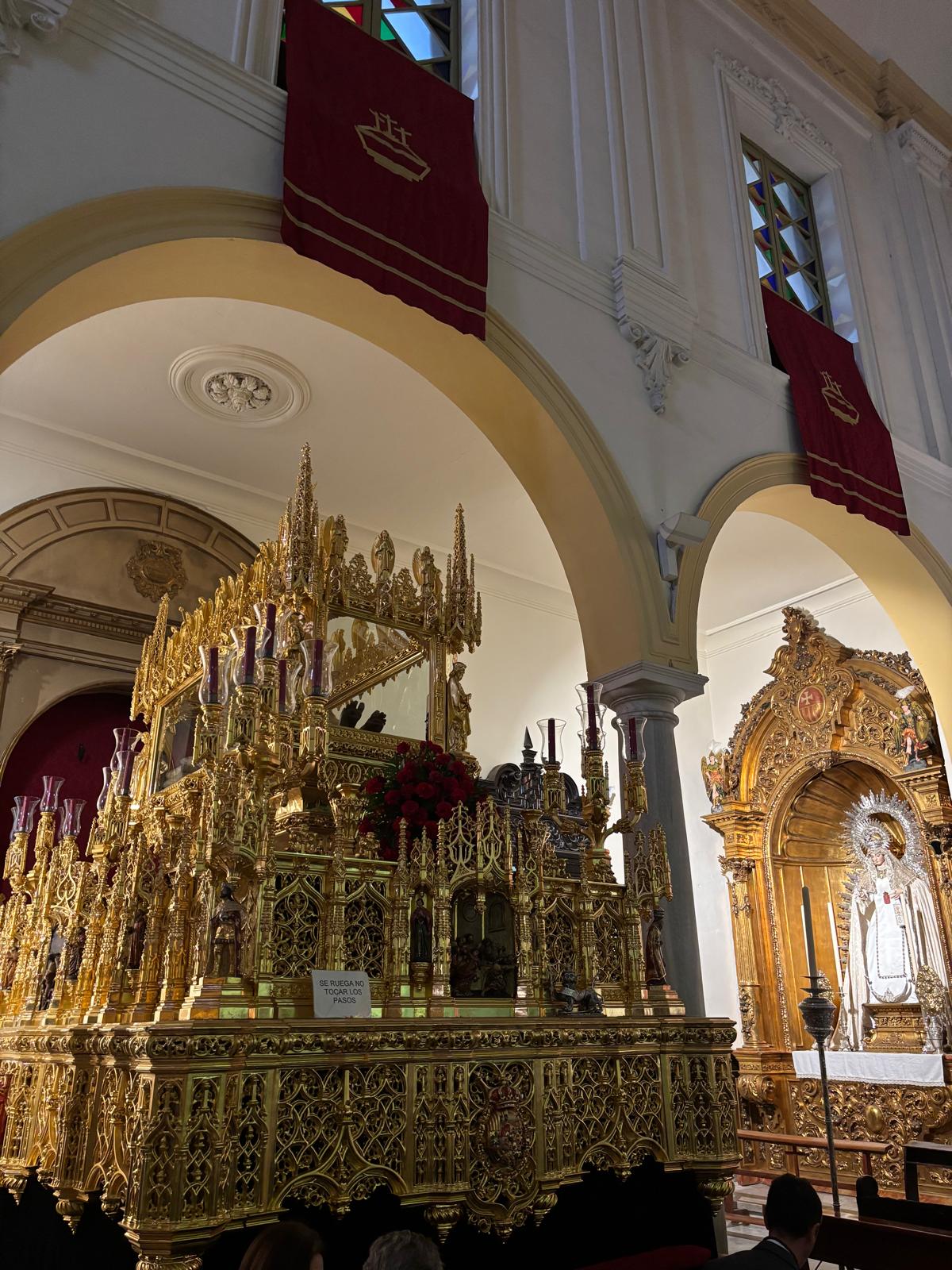
Holy Week in Seville, also known as Semana Santa, is renowned worldwide for its impressive processions, rich traditions, and profound religious significance. The Hermandad del Santo Entierro occupies a unique place within Semana Santa. Whilst most brotherhoods are characterized by exuberance and drama, Santo Entierro is distinguished above all by an air of austerity, solemnity, and silence. The Hermandad del Santo Entierro focuses on the moment of Christ’s death; this is a moment of reflection that precedes the hopeful resurrection.
History of Santo Entierro
The origins of the Hermandad del Santo Entierro date all the way back to the 16th century. Legends claim that the founding of the brotherhood is attributed to King Ferdinand III, but historical sources indicate that the brotherhood was already active around 1570. In its early days, the Hermandad del Santo Entierro was affiliated with the monastery of San Laureano. Since then, it has been based in various locations over the centuries.
Over the past few centuries, various events have forced the brotherhood to relocate on several occasions. These were historical events, such as wars and political upheavals. Following these various historical events, they found a permanent home in the 19th century, in the church of San Gregorio. The brotherhood’s long history reflects not only its resilience, but also its enduring significance within Seville’s religious and cultural identity.
There is something that makes the Hermandad del Santo Entierro particularly special, namely its connection to the Spanish monarchy. Within the brotherhood, the king is regarded as the highest representative, thereby reinforcing its status and ceremonial character.
More than just a brotherhood
The Hermandad del Santo Entierro is more than just an organization that organizes a procession every year; it is a vibrant community of believers dedicated to preserving traditions, religious celebrations, and charitable work. Throughout the year, the brotherhood also organizes various other religious activities.
In addition to its religious role, the Hermandad del Santo Entierro also plays an important social role. Members of the brotherhood feel connected through their faith and their involvement in the brotherhood. This sense of community is strengthened by the successive generations within the brotherhood. As a result, traditions are kept alive whilst at the same time being adapted to modern times.
A solemn procession
The procession of the Hermandad del Santo Entierro takes place on Holy Saturday. It is one of the most solemn and symbolic processions of the entire Semana Santa, with an atmosphere of silence and solemnity prevailing.
The procession consists of three floats, each with its own significance. The first float is the Triunfo de la Santa Cruz, an allegorical representation of the victory over death. On the float, you can find various symbols, such as a skeleton and references to the transience of life, as well as the victory of Christ.
The second paso is Cristo Yacente; on this paso, you can see the body of Christ lying in a glass urn. This paso often evokes emotional reactions from many spectators; the realism of the image emphasizes the gravity of the moment.
The third paso is the Virgen de Villaviciosa, where Mary is depicted in deep mourning. She symbolizes sorrow, but also the hope that can be drawn from faith.
What makes the Santo Entierro so special? It is the various representatives from different institutions; alongside the members of the brotherhood, civil, ecclesiastical, and military authorities also take part. This gives the procession a state ceremonial character.
Symbol of brotherhood
The Hermandad del Santo Entierro represents a pivotal moment in the story of Christ: the transition from death to life. The emphasis here is on silence, contemplation, and reflection. The procession serves as a reminder of the transience of life, but also of the promise of salvation. The paso depicting Christ in the tomb is not only a sign of loss, but also a harbinger of the Resurrection. Because of this dual meaning, the procession is regarded as powerful and profound.
The role today
Today, the Hermandad del Santo Entierro remains an important part of Semana Santa. The traditions are well preserved, yet the brotherhood is open to change. One example of this is the participation of women in recent years, which has been a significant step towards modernization.
The brotherhood is also taking responsibility for the future by carefully maintaining its artistic and religious heritage, such as the restoration of statues and the ongoing care of its historical possessions.
The Hermandad del Santo Entierro is one of the most impressive and significant brotherhoods of Semana Santa. This is due to its rich history, profound symbolism, and solemn processions. The brotherhood reminds us of the importance of silence and reflection.
Would you like to experience this impressive procession for yourself and really soak up the unique atmosphere of Semana Santa? Then look at our Instagram page for the daily Semana Santa schedules. Our daily bike tour also takes in several spots where the processions have passed or are yet to pass. If you have any other questions, we’re more than happy to answer them. Whether that’s online or in our shop, we’re here to help!
Adres: Calle Alcalde Isacio Contreras, 1, Sevilla
Website: www.atdspain.com
Instagram: @ATD.spain
TikTok: @ATD.spain
Facebook: Andalucia Tours and Discovery

