
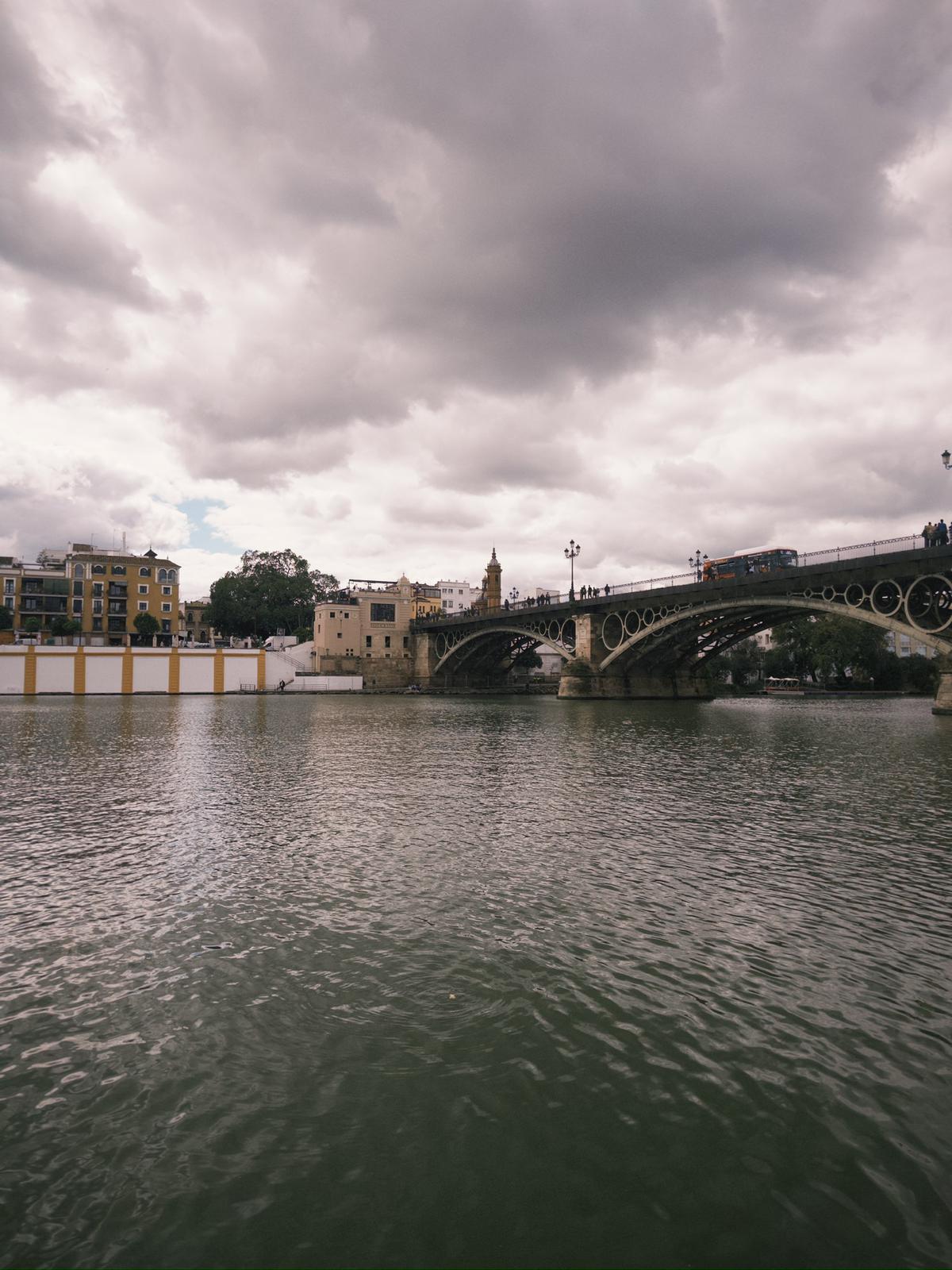
officially known as the Isabel II Bridge, is one of Seville’s most recognizable and iconic landmarks. It serves not only as a physical link across the Guadalquivir River but also as a symbolic bridge between the city’s historic center and the local Triana neighborhood. This blog explores the history, significance, and contemporary role of this remarkable bridge
A bridge with a long history
Before the current Puente de Triana was built, there was no permanent connection between Seville and Triana for centuries. Instead, people used a so-called bridge of boats (puente de barcas), a series of boats linked together with wooden planks laid across them. This was first constructed as early as the 12th century.
Although this did work, it came with many problems. The bridge was unstable and vulnerable to flooding from the Guadalquivir. During high water levels or bad weather, the crossing could even disappear entirely, which seriously jeopardized daily life and trade.
The need for a sturdy and permanent connection therefore grew increasingly urgent, especially as Seville began to develop into a modern city in the 19th century.
The Construction of the Current Bridge
The solution came in the form of the current Puente de Triana, whose construction began in 1845 and was completed in 1852. The bridge was designed by the French architects Gustavo Steinacher and Fernando Bernadet, and is largely made of cast iron.
The bridge’s design was based on a bridge in Paris spanning the Seine (the Pont du Carrousel). This demonstrates that Seville drew inspiration from other major European cities at the time. The bridge was opened during the reign of Queen Isabel II, to whom it owes its official name.
With a length of approximately 149 meters, it was the first permanent bridge over the Guadalquivir in Seville and, moreover, a significant technical feat for its time.
A Symbol of the City
Today, the Puente de Triana is much more than just an infrastructure project. It has become an important symbol of Seville and, above all, of the Triana neighborhood.
In 1976, the bridge was officially designated a historic monument. This underscores its significance to the city, both culturally and historically.
There are important landmarks on both sides of the bridge. On the Triana side, for example, you’ll find the Plaza del Altozano and the famous neighborhood with its flamenco and ceramics traditions. On the other side lies Seville’s historic center, home to monuments and tourist highlights.
The bridge thus serves as the gateway to Triana, both literally and figuratively.
The Puente de Triana Today
Today, the bridge is one of the city’s most popular spots. Both tourists and locals use it daily, not only to cross the river but also to enjoy the view.
Especially at sunset and in the evening, the bridge offers a beautiful view of the Guadalquivir and the city. It is therefore a popular spot for walks and photography.
In addition, the bridge still plays an important role in the daily life of Seville. It is a major thoroughfare, but at the same time a place where culture and history converge.
In conclusion
The Puente de Triana is a perfect example of how something practical can eventually become an important symbol for a city. What was once simply a necessity for crossing the river is now one of Seville’s most famous landmarks.
The bridge also reflects a piece of history: from a simple boat bridge to a sturdy iron structure that still stands today. At the same time, it’s simply a place where people walk, cycle, and gather every day.
So for both residents and tourists, it’s not just any bridge, but truly a place that belongs to Seville.
Want to learn more about this beautiful bridge or see it in person? On our daily bike tour, you’ll pass this impressive bridge several times. If you have any other questions, we’re more than happy to answer them. Whether online or in our shop, we’re here to help!
Adres: Calle Alcalde Isacio Contreras, 1, Sevilla
Website: www.atdspain.com
Instagram: @ATD.spain
TikTok: @ATD.spain
Facebook: Andalucia Tours and Discovery

