
A city ready for a fresh start
At the beginning of the twentieth century, Seville wanted to put itself back on the international map. Although the city had a rich history, it was struggling to keep up economically with other major Spanish cities. The solution was ambitious: organizing the Ibero-American Exposition of 1929.
The event was created to strengthen the relationship between Spain and the countries of Latin America that had once been part of the Spanish Empire. At the same time, Seville wanted to present itself as a modern and welcoming city.
Years of preparation followed. New roads, parks, buildings and public squares were built before the exhibition officially opened in May 1929. It remained open until June 1930 and welcomed visitors from around the world.
Plaza de España became the city’s symbol
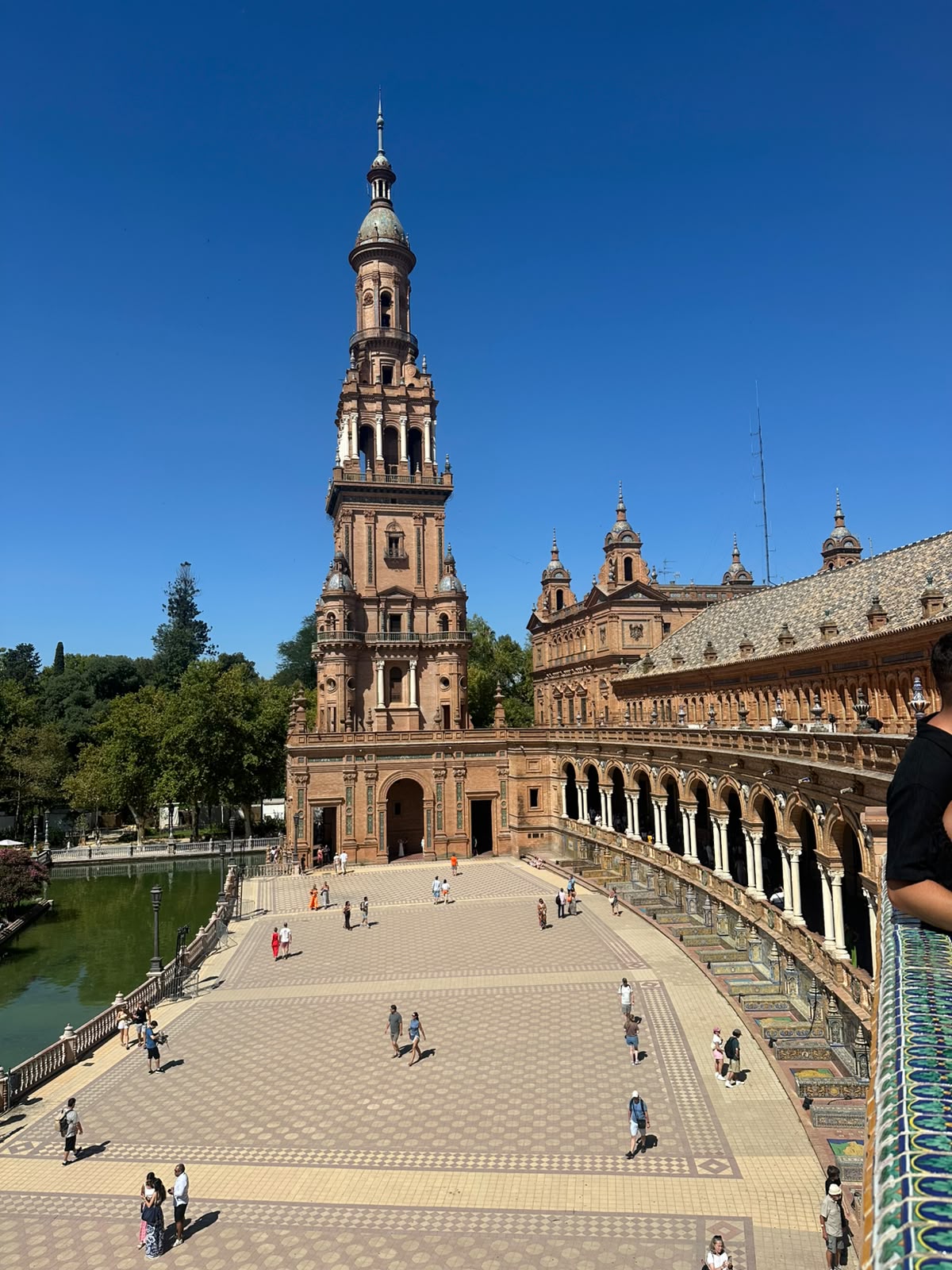
The most famous legacy of the exhibition is Plaza de España. Designed by architect Aníbal González, the enormous semi-circular square was built as a symbol of Spain’s unity and strength.
One of its most famous features is the row of 48 beautifully decorated ceramic benches, each representing one Spanish province. The bridges crossing the canal symbolize the ancient kingdoms of Spain, while the building combines Renaissance, Baroque and Mudéjar architecture.
Today, Plaza de España is one of Seville’s biggest tourist attractions and has even appeared in movies such as Star Wars: Attack of the Clones.
María Luisa Park became the city’s green heart
Another important part of the exhibition was María Luisa Park. Although the land had already been donated to the city by Princess María Luisa, the park was completely redesigned by French landscape architect Jean-Claude Nicolas Forestier.
New gardens, fountains, ponds and shaded walking paths created the perfect setting for visitors. Many exhibition pavilions were built throughout the park, turning it into one of the most beautiful areas of the event.
Today it remains one of the most relaxing places in Seville for both locals and tourists.
International pavilions with lasting importance
Many countries built their own exhibition pavilions to showcase their culture, traditions and economic achievements. Most participating nations came from Latin America because the exhibition celebrated the historical connection between these countries and Spain.
Unlike many world exhibitions where temporary buildings disappear afterwards, many of Seville’s pavilions are still standing today. Several have been converted into embassies, consulates, museums and government offices.
Walking around the exhibition area almost feels like visiting an open-air museum.
A modern city was born
Hosting the exhibition required major improvements throughout Seville. Roads became wider, new infrastructure was added and public spaces were modernized to welcome thousands of international visitors.
The event also brought worldwide attention to the city. Newspapers across Europe and the Americas wrote about Seville, helping to establish it as an attractive travel destination.
Although the Great Depression limited the financial success of the exhibition, the long-term impact on the city was enormous.
Architecture that still defines Seville
One of the exhibition’s greatest achievements is its architecture. Buildings from this period combine traditional Andalusian elements with early twentieth-century design.
Ceramic tiles, horseshoe arches, elegant towers and colourful decorations can still be found across the exhibition grounds. Architect Aníbal González played a key role in creating this distinctive style, which continues to shape Seville’s identity today.
These buildings show how history and innovation can exist side by side.
A legacy that never disappeared
Nearly a century later, the influence of the 1929 World Exhibition is still visible everywhere. Every day, thousands of visitors walk through Plaza de España, relax in María Luisa Park and admire the historic pavilions, often without realizing they were all created for the exhibition.
The event transformed Seville into an international city while preserving its historical character. Many of the city’s most famous landmarks simply would not exist without the World Exhibition of 1929.
Anyone exploring Seville today is still experiencing the lasting legacy of one of the most important events in the city’s modern history.
Would you like to see many more of these beautiful, historic buildings? Our daily highlights bike tour takes us past several of
them. We would be happy to answer any other questions you might have. Whether
online or in our shop, we are here to help!
Adres: Calle Alcalde Isacio Contreras, 1, Sevilla
Website: www.atdspain.com
Instagram: @ATD.spain
TikTok: @ATD.spain
Facebook: Andalucia Tours and Discovery

