
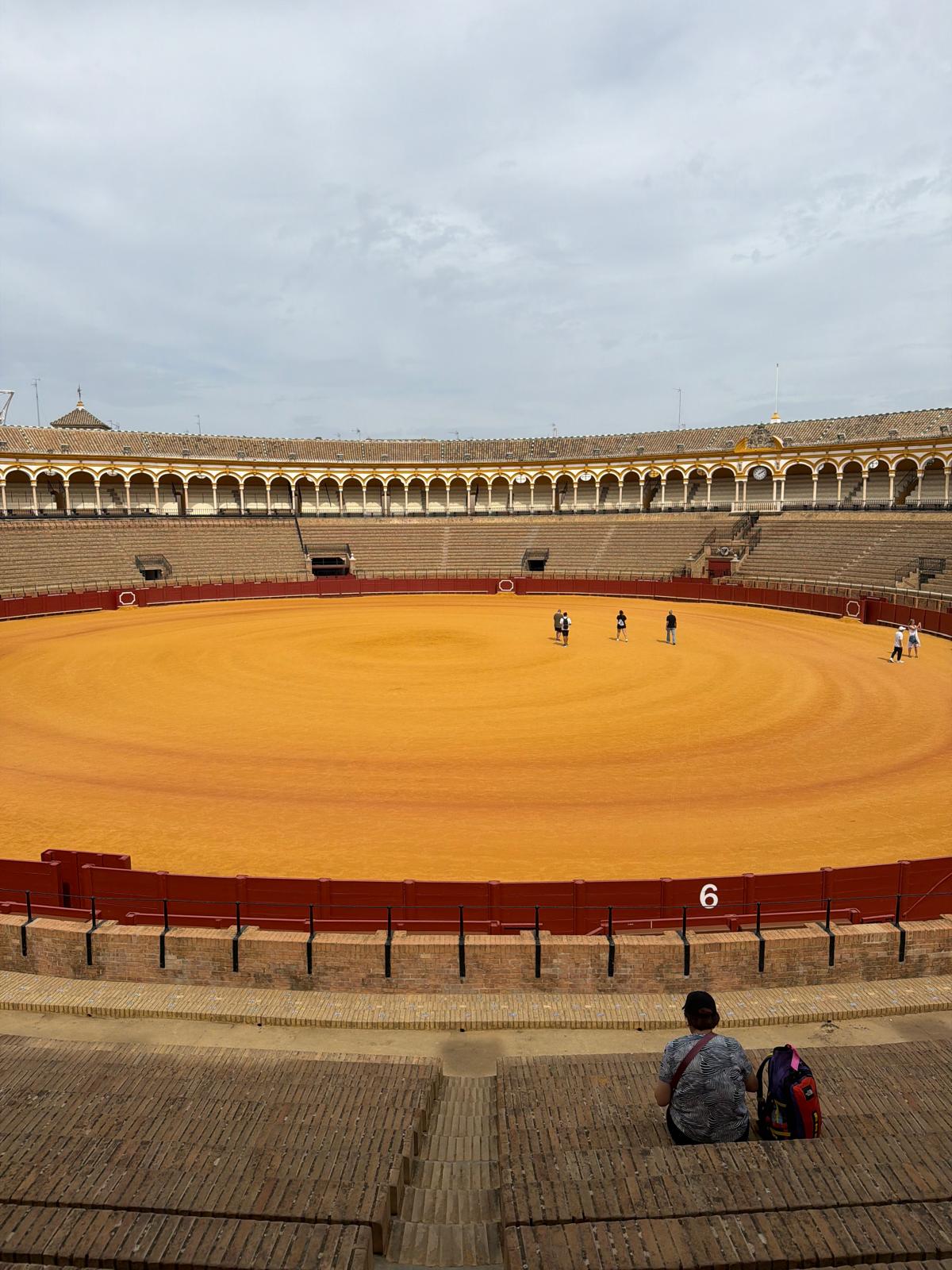
During a visit to Seville, the Plaza de Toros is a place you simply cannot miss. This famous arena is located in the El Arenal district, right next to the Guadalquivir River, and is one of the best-known sights in the city. The building is not only beautiful to look at, but also tells you a great deal about Spanish culture and history.
The history of the arena
The Plaza de Toros de la Real Maestranza is one of the oldest and most respected bullrings in Spain. The story begins in 1749, when the Real Maestranza de Caballería de Sevilla, a noble equestrian society, began construction. This society had a long-standing connection with horsemanship and bullfighting culture, and that bond can still be seen in the name of the arena.
The construction was not the work of just a few years. At first the arena was partly made of wood and did not have the round shape we know today. Over the following decades the building was gradually rebuilt and replaced with stone, slowly taking on its present form. The structure was not completed until 1881, as we know it now. This means the arena was literally centuries in the making, and you can see it in the combination of styles.
That also makes the building architecturally interesting. You will see baroque elements, such as the elegant arches and rich details, combined with the whitewashed walls and ochre-yellow accents so typical of Andalusia. The arena is almost perfectly round and has room for around twelve thousand spectators. The sand in the middle measures about sixty metres across. Around the ring run covered galleries with stone columns, and the stands are built up in several tiers, so you have a good view of the action from every seat.
One of the best-known features is the Puerta del Príncipe, the “Prince’s Gate”. Through this gate the finest matadors leave the arena after an exceptional performance. In the bullfighting world it is a great honour to be carried out through this door, and it happens only rarely. This makes the gate a kind of symbol of the arena.
The Plaza de Toros also played an important role in the development of bullfighting itself. In the eighteenth century the sport grew into a true popular spectacle, and Seville, together with Ronda, became one of the most important places where the modern style of bullfighting developed. Famous bullfighters from that era, such as Pedro Romero from Ronda and Pepe-Hillo from Seville, were known for their rivalry and their different styles. Their performances added to the fame of the arena, far beyond the borders of Andalusia.
Outside of bullfighting, too, the building holds an important place in the cultural life of the city. Seville features in many Spanish stories, operas and songs, and the arena is inseparable from that. For many Sevillanos the Maestranza is more than a sports venue: it is a landmark of their city.
Bullfighting and Spanish traditions
The arena is best known for bullfighting, a tradition that has existed in Spain for centuries. Important events take place especially during the Feria de Abril, Seville’s famous spring festival. For some Spaniards, bullfighting is part of their cultural heritage. Others are firmly against it because of animal suffering. As a result, it is a tradition that sparks a great deal of debate.
What does a bullfight look like?
A traditional bullfight consists of several stages. In the first stage, the matador or one of his assistants uses a large pink and yellow cape to challenge the bull and observe how it moves and reacts. Next, the picador enters the arena on horseback. He uses a long lance, the pica, to pierce the bull’s neck muscles. This usually happens once or twice, which weakens the bull. Then the banderilleros take over. They place decorated sticks, called banderillas, in the bull’s back. Usually there are six of them, in three pairs. In the final stage the matador takes over with a red cape, with which he guides the bull around the arena. Finally, he attempts to kill the bull with a sword.
Bullfighting is a centuries-old Spanish tradition, but it is widely debated because of animal suffering. Visitors to the arena do not have to let this decide their visit: you can also simply see the building as a piece of history and architecture, outside of event days.
Visiting the arena and the museum
If you want to see the arena from the inside, you can take a guided tour. You walk past the stands and along the edge of the ring, and you also visit the bullfighting museum next door. There you can see traditional costumes, paintings, posters and objects connected with the history of bullfighting. The museum gives a good impression of how deeply rooted this tradition is in Sevillian culture, even for those who have mixed feelings about it.
The Plaza de Toros during the bike tour
During the bike tour through Seville we may pass the Plaza de Toros. This allows us to see this famous arena up close and learn more about its history. Would you like to explore the arena in more depth? Then you can also rent a bike yourself and cycle there to discover the arena and the museum. The area around the Guadalquivir is flat and easy to reach by bike, so it makes a pleasant stop during a day in the city.
Address: Calle Alcalde Isacio Contreras, 1, Seville
Website: www.atdspain.com
Instagram: @ATD.spain
TikTok: @ATD.spain

