
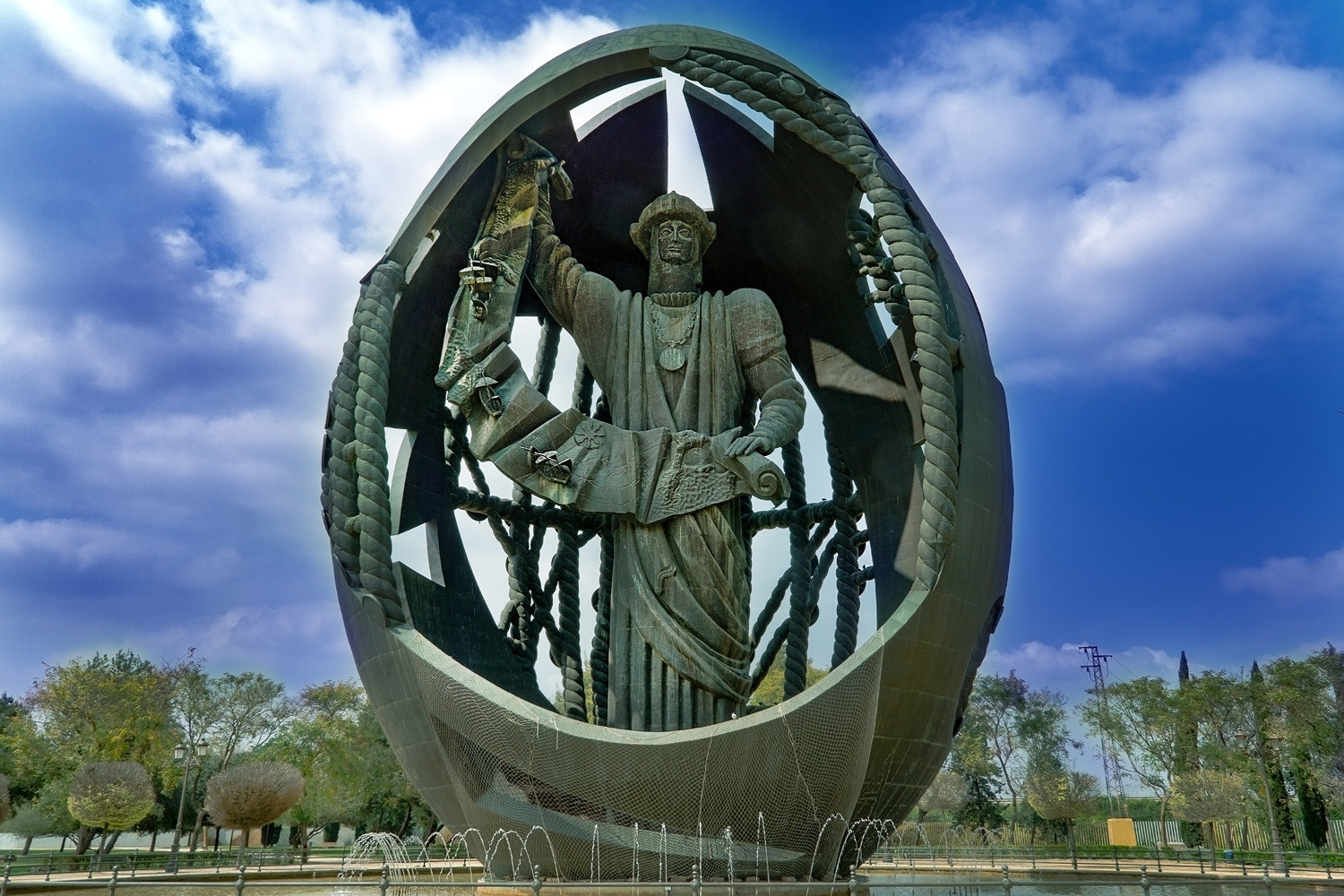
A striking monument
Anyone exploring Seville will come across many impressive buildings, squares and monuments. One monument that immediately stands out is the Columbus Egg, known in Spanish as El Nacimiento de un Hombre Nuevo. The enormous sculpture is located in Parque de San Jerónimo, in the northern part of Seville, and is a remarkable part of the city’s landscape.
Who was Christopher Columbus?
Christopher Columbus was an explorer who lived in the 15th century. He was probably born in Genoa, in present-day Italy. Columbus wanted to find a new sea route to Asia by sailing west from Europe. In 1492, he set out with three ships, the Niña, the Pinta and the Santa María, on a journey across the Atlantic Ocean.
On October 12, 1492, Columbus reached islands in the Caribbean. At first, he believed he had reached part of Asia, but the areas he reached were part of a continent that was unknown to Europeans. His voyages had major consequences for the history of Europe and America. They led to more European expeditions, trade and colonization, but also had very serious consequences for the Indigenous peoples of the Americas.
Columbus is therefore a historical figure with a complex legacy. His voyages are often described as the beginning of a new period of contact between Europe and the Americas, while today there is also considerable attention to colonization, violence and its consequences for Indigenous peoples.
Why is Columbus connected to Seville?
The monument’s connection to Columbus is related to the important role that Seville played in the history of the voyages of exploration. After Columbus’s voyage in 1492, Seville became an important center for trade and expeditions to the New World. The city was located along the Guadalquivir River, giving it an important strategic position. Ships could travel from Seville along the river towards the Atlantic Ocean.
Why is it called the “Columbus Egg”?
The name “Columbus Egg” comes from the monument’s unusual shape. It is not simply a statue of a person, but a large structure in which Columbus appears to be surrounded by a huge egg-shaped form. The monument is easy to recognize from a distance. Its white color also makes it stand out strongly against the green surroundings of the park.
The monument’s official name is El Nacimiento de un Hombre Nuevo, which roughly means “The Birth of a New Man.” It was designed by the Georgian-Russian artist Zurab Tsereteli and was placed in Seville in 1995. The monument is approximately 45 meters high and consists of large white, egg-shaped panels. Inside this structure is a statue of Columbus with his hands held together.
A monument with different meanings
The monument refers to an important part of Seville’s history and the voyages of exploration. The egg shape can be seen as a symbol of a new beginning and a new world. At the same time, the historical significance of Columbus is now a subject of discussion, because the European voyages of exploration also had major consequences for the Indigenous peoples of the Americas.
The monument can therefore be viewed in different ways. For some people, it represents exploration and an important moment in history, while others may focus more on the consequences of European colonization.
Discover the Columbus Egg by bicycle
The Columbus Egg is located outside Seville’s historic city center. A fun way to visit the monument is therefore by bicycle. Cycling allows you to easily travel through different parts of Seville and see more of the city along the way.
You can, for example, rent a bicycle from ATD Bikes. From the city center, you can cycle towards Parque de San Jerónimo. This turns a visit to the Columbus Egg into a fun bike ride through Seville. Cycling also gives you more flexibility and means you do not have to depend on public transportation.
Address: Calle Alcalde Isacio Contreras, 1, Seville
Website: www.atdspain.com
Instagram: @ATD.spain
TikTok: @ATD.spain

