
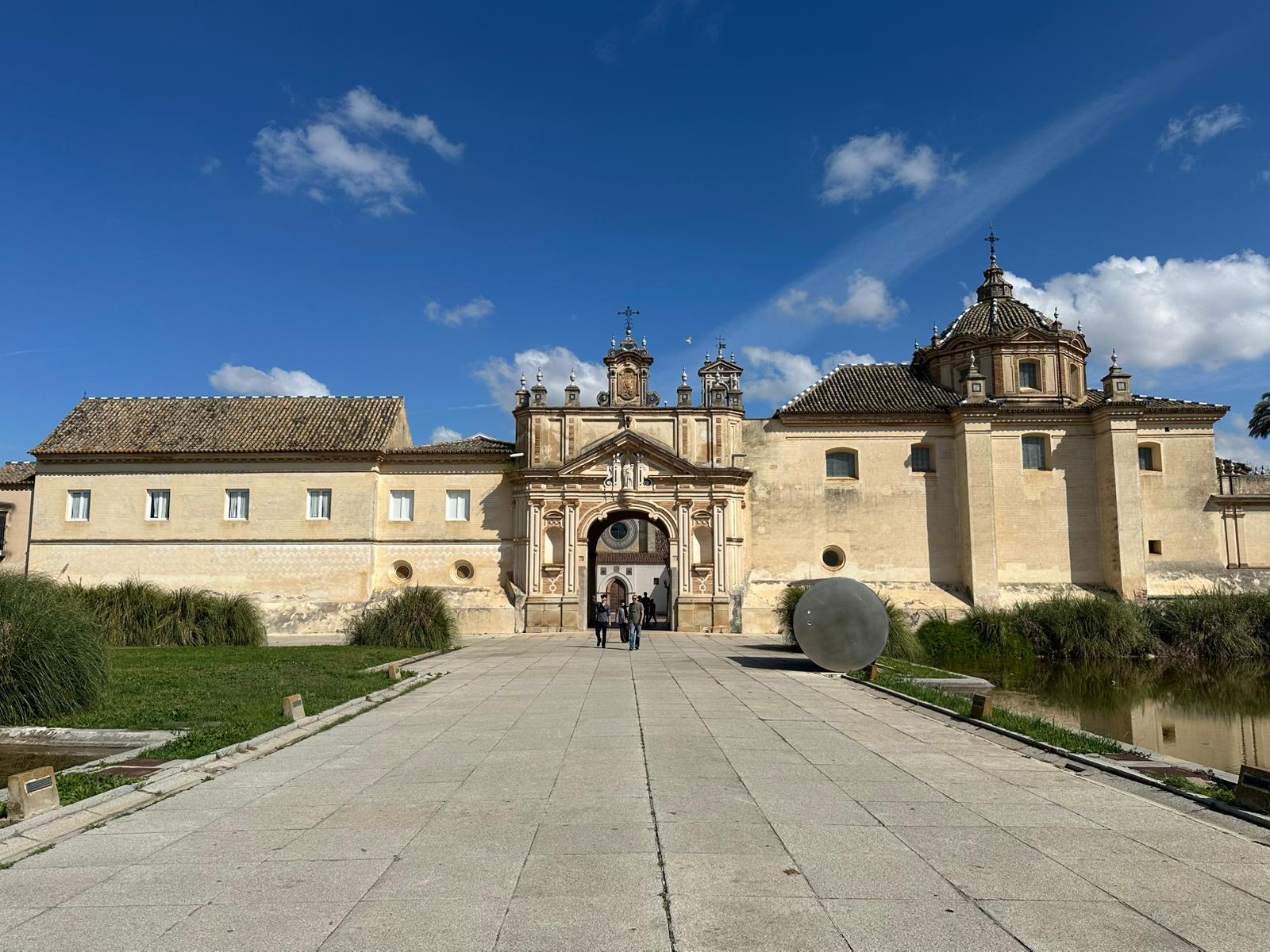
When you think of Seville, you probably immediately think of the cathedral, the Alcázar, or the lively streets filled with tapas. But slightly less well-known—and perhaps all the more interesting for it, is the Cartuja Monastery, officially known as the Monasterio de Santa María de las Cuevas. This remarkable building is located on the Isla de la Cartuja, on the Guadalquivir River, and has served a variety of purposes over the centuries. What makes this monastery so unique is that it has not only been a religious site, but also a factory, a historic monument, and, today, a center for modern art.
The Monastery’s Origins
The monastery was founded around the year 1400 by Gonzalo de Mena. According to an old legend, there had already been a sacred site at this location, as a statue of the Virgin Mary was found in the ground in 1248. This statue was named “Virgen de las Cuevas” (Virgin of the Caves), and that is also where the monastery’s name comes from.
The site where the monastery stands was already significant before its construction. During the Arab period, the clay soil here was used to make ceramics and tiles, something for which the Triana district is still famous today!
From the 15th century onward, the monastery was occupied by Carthusian monks. They lived in silence and seclusion, which suited the peaceful setting of the island well. The monastery grew into an important religious site in Seville.
The Role of Columbus
One of the most interesting aspects of the Cartuja Monastery is its connection to Christopher Columbus. He stayed here after his first voyage to the Americas and was taken in by the monks. He also made some of his preparations for his expeditions at this site.
In addition, Columbus’s remains were interred in the monastery’s Santa Ana Chapel between 1509 and 1536. As a result, this chapel even earned the nickname “Capilla de Colón” (Columbus Chapel).
From Monastery to Factory
In the 19th century, the monastery’s purpose changed completely. In 1835, the monastery was closed and later purchased by the English entrepreneur Charles Pickman. He turned it into a ceramics factory that became internationally renowned!
This factory produced high-quality earthenware and porcelain, making Seville famous worldwide for its ceramics. The tall chimneys that can still be seen today serve as a reminder of this period.
It’s quite remarkable that a single building underwent such a dramatic transformation: from a quiet monastery to a bustling factory.
Expo ’92 and Restoration
The monastery was thoroughly restored for the 1992 World’s Fair (Expo ’92). During the expo, it even served as the main headquarters.
The Expo’s theme was the discovery of America, exactly 500 years after Columbus’s voyage. That makes it logical that this historic site played such an important role during the event.
After the Expo, the monastery took on a new function, but this time it remained more closely connected to culture and history.
The monastery today: modern art
Today, the Cartuja monastery is home to the Centro Andaluz de Arte Contemporáneo (CAAC), or the Andalusian Center for Contemporary Art.
This museum exhibits modern artworks and also hosts events such as concerts, workshops, and lectures. What makes it extra special is the combination of old and new elements: you walk through a centuries-old monastery while viewing modern art! How cool is that?
In addition, you can still see many original parts of the monastery, such as the Gothic church, the cloisters, and the old chapels.
This blend of history and modern culture makes it a unique spot in Seville—something many people don’t know!
Why You Should Definitely Visit the Cartuja Monastery
What makes the Cartuja Monastery so interesting varies. It’s not just any historical building, but a place that has continually adapted to the times. From a religious monastery to a factory and finally to a museum, you don’t see that very often.
Its location on Isla de la Cartuja also makes it special. This area is quieter than the center of Seville and has a completely different atmosphere!
As a visitor, you can not only view art here but also simply walk around and experience the history of the place. You can literally see traces of different eras within a single building.
Would you like to see this secluded monastery and all its secrets for yourself? On our daily bike tour, we pass by the Cartuja Monastery! If you have any other questions, we’re more than happy to answer them. Whether online or in our store, we’re here to help!
Adres: Calle Alcalde Isacio Contreras, 1, Sevilla
Website: www.atdspain.com
Instagram: @ATD.spain
TikTok: @ATD.spain
Facebook: Andalucia Tours and Discovery

